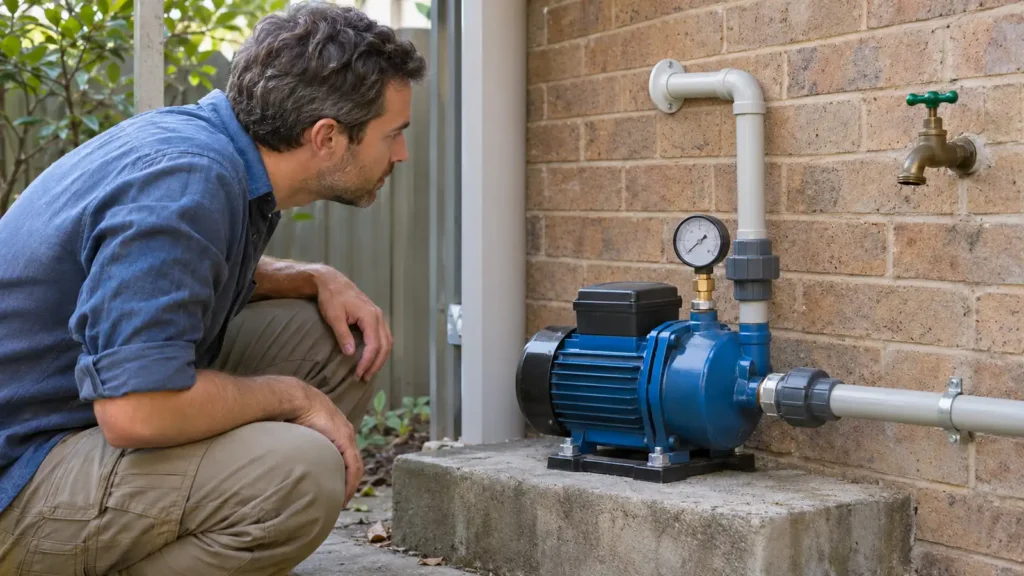
A useful borehole pump maintenance checklist combines repeatable operating readings, external condition checks and a written service history. Keep the original installation data, observe the system under comparable conditions and act on changes before the next scheduled visit. Routine monitoring does not require removing the pump from the borehole.
This guide is for keeping a working installation under observation. If water delivery has stopped, use the borehole pump running but no water guide. If water still arrives but delivery is weak, use the borehole and tank low-pressure guide for the detailed fault checks.
1. Keep a baseline that the next visit can use
Start a file for the borehole and its equipment. Keep the borehole report, pump and motor models, controller identity, installation depth, pipe route, original performance readings, water analyses and previous repairs together. Photographs of nameplates and accessible equipment help identify the actual installation later.
The Grundfos submersible pump installation record shows the value of recording hydraulic conditions alongside motor, cable and control information. Its electrical fields are for the appropriate installer or technician; they are not instructions for an owner to open a control box.
Use readings taken when the system was confirmed to be operating satisfactorily as the baseline. A later entry should identify the same outlet route, gauge location, demand and control mode. Note how long the pump had been running when the observation was made. A newly opened irrigation zone or a changed speed setting can alter delivery without proving that the pump has deteriorated.
If no commissioning record exists, keep the information you can verify and mark the rest unknown. Ask the installer to establish a documented reference under known conditions. Do not turn an unexplained current fault into the “normal” baseline. The installation and commissioning checklist helps identify missing handover information.
2. Use this external inspection checklist
During a normal site visit, look at accessible equipment and read existing displays without dismantling anything. Record a change even if water is still being delivered.
| Item | What to observe and record |
|---|---|
| Borehole surroundings | Visible damage to the cap or casing, ponding, changed drainage, recent works or contamination concerns. |
| Above-ground pipework | New leaks, damaged supports, movement, exposed pipe damage or changes to the delivery route. |
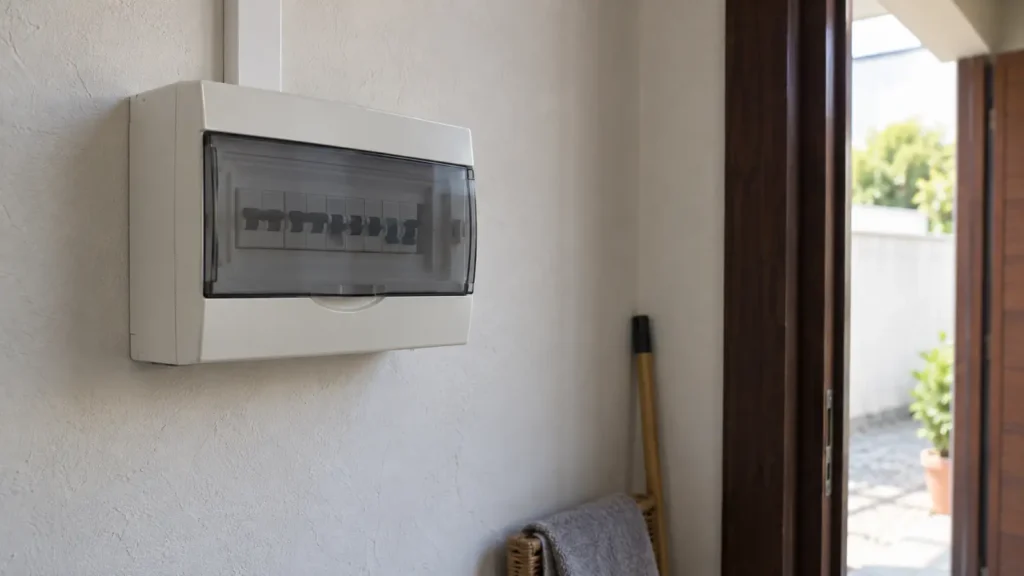
| Closed control enclosure | Exterior damage, an unlatched door, damaged visible cable entries or conduits, and externally visible alarms. |
| Operation | Starts and stops during a recorded observation period, unusually long runs for the same duty, or changed accessible equipment noise. |
| Storage and treatment | Tank-level and refill trend, lid condition, external leaks, and filters or treatment components due for service. |
| Water appearance | New sand, cloudiness, colour, odour or staining, with the date and location where it was noticed. |

Observe the control enclosure from outside. A sound-looking cover does not prove the internal electrical equipment is dry or safe. Have a qualified person investigate damaged entries, signs of water ingress or electrical faults. Do not touch suspect equipment, open covers or repeatedly reset a protective trip to continue operating.
Check filters, pressure vessels, tank controls and treatment equipment against their own maintenance instructions. A pump system can need attention at the surface while the downhole pump remains in place. Do not add oil or grease to a submersible motor as a generic maintenance step; its actual construction and service instructions determine the work.
For water used for drinking, keep the applicable sampling and laboratory-testing programme separate from this visual checklist. Record the sample point and whether it is raw or treated water. Clear water, a new filter or restored pump flow does not establish drinking-water safety. NGWA’s well inspection guidance includes sanitary condition and water-quality checks alongside pump performance.
3. Record flow, pressure and operating conditions together
A maintenance log is useful when it describes the circumstances of each reading. “Flow is lower” is less informative than a measurement at the same point with the demand, pump state and timing recorded.
Read a cumulative water meter correctly
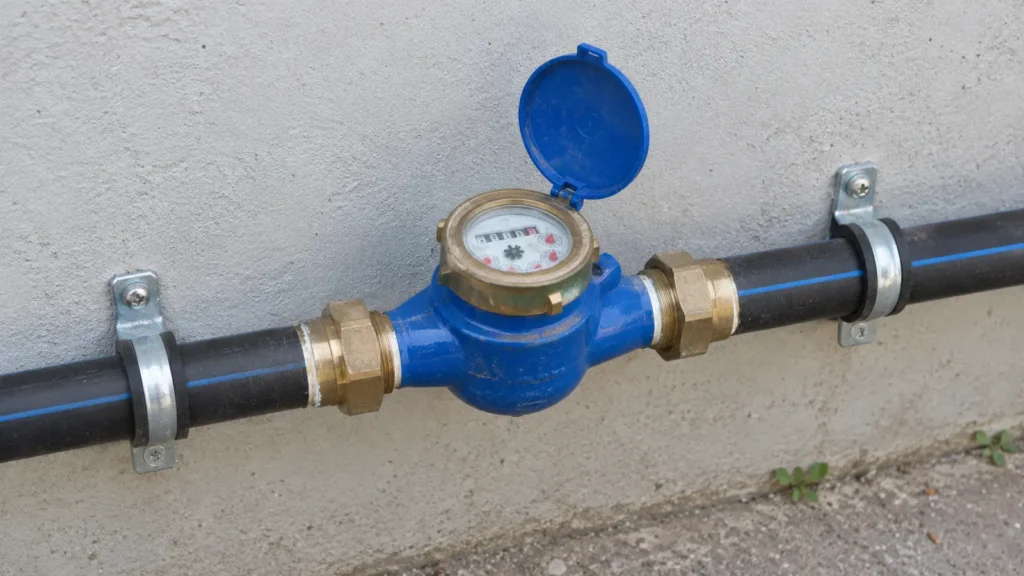
A totalizer shows the volume that has passed through the meter, not the instantaneous flow rate. Check its units, decimal positions and any multiplier before copying the reading. Oregon State University explains the distinction between a totalizer and a flow-rate display.
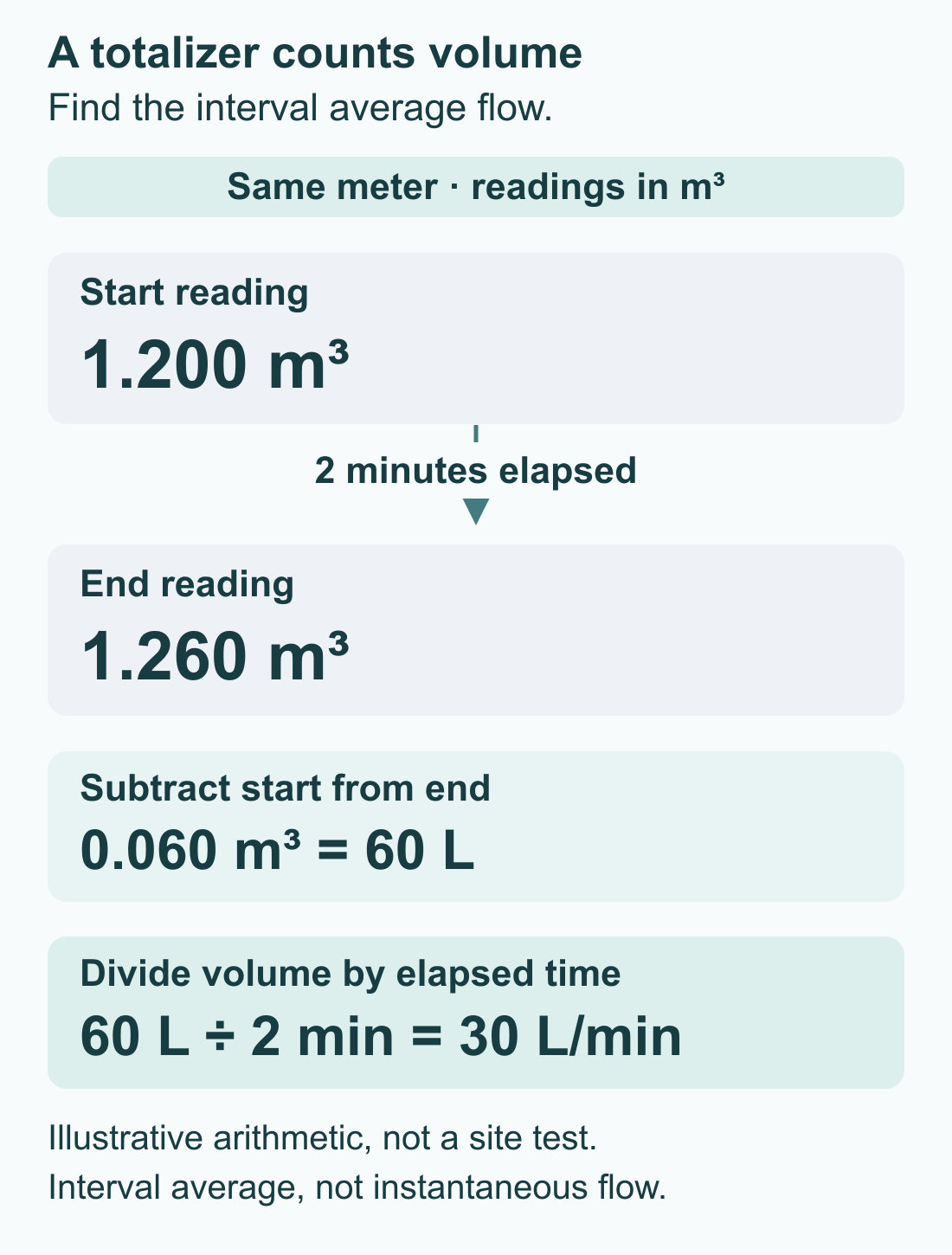
To calculate the average flow over an observed interval, subtract the first cumulative reading from the second and divide the volume by the elapsed time. For readings in cubic metres and time in minutes:
Average flow in L/min = (end reading − start reading) × 1,000 ÷ elapsed minutes.
For example, 1.200 m³ at the start and 1.260 m³ two minutes later gives 0.060 m³, or 60 litres. The interval average is 60 ÷ 2 = 30 L/min. These are illustrative numbers, not QDD test results or a recommended flow rate.
The result describes water passing that meter during that interval. Confirm which route it measures and whether other flows are included. If the interval includes pump stops, label that fact: the average is not the pump’s continuous-running output. For a comparison of steady operation, use an appropriate normal operating interval; do not defeat level controls or alter the system into an unsafe test condition.
Keep long-term total-volume readings too. They show how much water was delivered over the recorded period, but a larger monthly total can simply mean greater demand. A meter after a storage tank records downstream delivery; it does not directly record borehole refill during the same period.
Name the pressure point and pump state
Record the pressure unit and gauge location, the outlets drawing water, and whether the pump is running, stopped or cycling. A pressure setting on a controller and a measured gauge reading are different fields. Keep them labelled separately.
In a borehole-to-vented-tank system, distinguish the borehole filling line from the downstream booster supply. House pressure alone cannot identify the pressure at the borehole discharge. Keep each stage’s readings with its own operating conditions.
Add water-level and electrical results when professionally measured
Ask the service person to record the water-level reference point, depth to water and elapsed pumping time. A pumping level measured shortly after starting may differ from one measured later. Record a resting level with its recovery conditions; do not assume any brief stop has fully restored the static level.
Keep professional voltage, current and insulation-test results with the equipment identity and test conditions. Specify whether a value came from a controller display or a separate measurement, and what was actually tested. There is no single insulation-resistance or current limit that can be applied to every motor, cable and drive arrangement.
Franklin Electric’s well-pump troubleshooting guidance uses combined hydraulic and electrical evidence and checks changes above ground before assuming a pump must be retrieved. That principle also makes periodic maintenance records more useful.
4. How often should a borehole pump be checked?
Separate observation, trend measurement and professional service. Their intervals need not be identical.
- During routine site visits: note visible leaks, enclosure condition, displayed faults, storage behaviour and unusual operating changes.
- At an agreed recurring interval: repeat the same operating observation and add dated readings to the log. Set the interval with the installer around usage, access and the consequences of losing supply.
- Before a demanding season or restart after a long shutdown: review the last service, outstanding work and the equipment’s start-up instructions. Arrange due work before relying on full output.
- When the equipment instructions or service plan require it: complete the relevant filter, vessel, controller, pump or other component work and save the result.
- After an abnormal event: record a power interruption, flooding, damaged equipment, repeated protection trips or an unexpected delivery change and seek the appropriate assessment without waiting for the routine date.
NGWA’s US-facing guidance recommends an annual professional well-system inspection for household wells. That recommendation is a useful reference for planning professional review; it does not mean annual pump removal or establish a universal legal service interval for another country.
Actual service needs depend on the equipment and installation. The Grundfos SP engineering manual discusses service intervals in relation to materials, operating conditions and the pumped water. Follow the applicable pump and motor manuals, local requirements and the service plan for this site. More demanding use or a developing trend can justify an earlier assessment.
5. Use a change in the record to decide the next step
First check whether the observations are comparable and whether the instruments are giving credible readings. Then ask the service person to investigate the change, rather than prescribing a replacement from one number.
- Lower flow under comparable conditions: provide the flow, pressure, pump state and any available water-level record together. Changes in source conditions, restrictions, controls and pump performance need different responses.
- Longer tank-filling time: record the start and end levels, other use from the tank, and interruptions during filling. Elapsed time alone does not isolate reduced pump output if water is also being withdrawn.
- More frequent starts or repeated protection events: save the actual observation period, fault text, controller model and preceding conditions. Do not infer the cause from a code without the matching manual.
- New sediment or appearance changes: record where and when they occur and arrange appropriate source, equipment or water-quality assessment. Do not decide on borehole cleaning chemicals from colour alone.
For solar-powered installations, record sunlight or shade conditions, controller state and operating time when comparing delivery. A short observation on an overcast day is not directly comparable with one under strong sunlight. Daily delivered volume and tank replenishment can be more useful than an isolated flow reading, provided demand and conditions are recorded.
Keep the original baseline after repairs. Add what changed and the post-service reading under a stated test condition. If the accepted system configuration has changed, establish a new reference and retain the old history.
6. Copy this maintenance record
Use one entry per visit or defined observation. Add the unit and measurement source beside each value; leave unknowns marked as unknown.
| Record | Details to enter |
|---|---|
| Date and identity | Date/time, borehole or site ID, observer, pump/motor/controller models. |
| Operating conditions | Outlet route, other demand, control mode/speed, pump state and time since start. |
| Meter and delivery | Meter location and units, start/end readings, elapsed time, interval flow and total volume. |
| Pressure | Gauge location and unit, measured reading, demand and pump state; settings separately labelled. |
| Source and storage | Tank levels/refill, and professional water-level readings with reference point and timing. |
| Condition and events | Leaks, damage, sediment, fault text, start/stop observation, recent power or system changes. |
| Service and tests | Work completed, parts and settings changed, professional measurements, laboratory report references. |
| Follow-up | Result of comparable recheck, open issue, responsible person and next action/date. |
A professional service report should identify the equipment and scope, give the measurements and their interpretation, record any protection or control checks performed under the applicable procedure, and list completed and outstanding work. Electrical testing, opening the borehole, pressure-vessel servicing and protection-function tests belong with the appropriate qualified personnel. Do not test dry-run protection by deliberately starving the pump of water.
Ask whether the reported work involved surface checks, downhole retrieval or borehole rehabilitation; these are different scopes. Agree on the reason and evidence for any proposed removal. Record how the result will be verified after the work.
Keep the log with the manuals, commissioning report and previous service records. For QDD equipment support, send the model identification, fault information and relevant entries through QDD support. This gives the next person a documented operating history to work from.