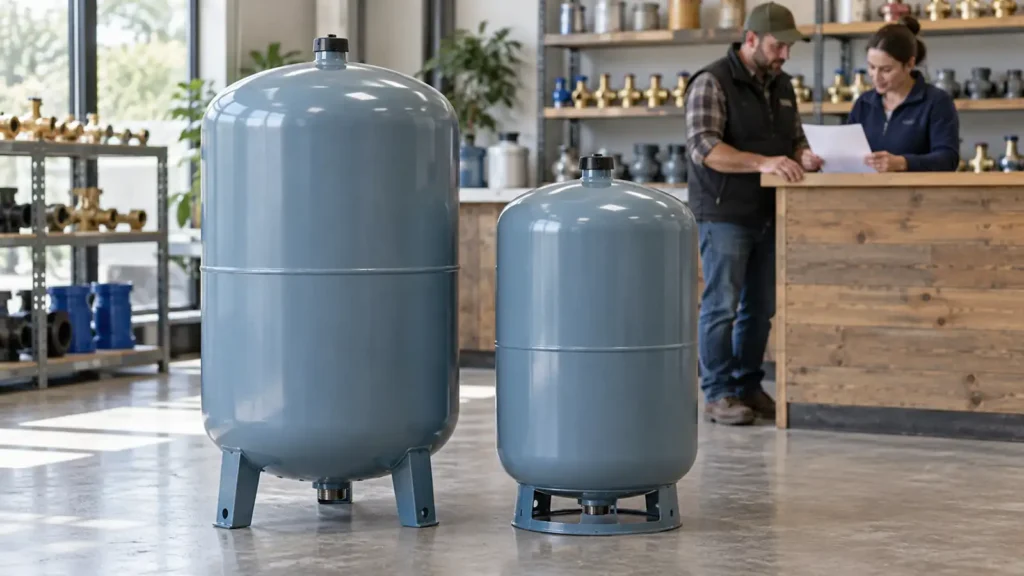
Choose a pressure tank by the water it can deliver between pump stops and starts, then check that this gives the pump enough running time. The large litre figure on the label is the tank’s total volume. It is not the amount of water available before the pump starts again.
If you are comparing a 60 L tank with a 100 L tank, ask for the drawdown at your system’s start and stop pressures. You can begin with photos of the existing tank label and pump controller, plus a description of when the pump starts. You do not need to know every setting before asking for help.
What the tank’s litre rating actually means
A precharged diaphragm or bladder tank contains both water and compressed air, separated by a flexible membrane. As the pump fills the tank, the air compresses. After the pump stops, expanding air pushes water into the pipework as you open a tap.
The pressure falls until the pressure switch starts the pump again. The water delivered during that fall is the drawdown. Cut-out means the pressure at which the pump stops; cut-in means the pressure at which it starts. Global Water Solutions explains these terms and the air cushion’s role.
The tank still needs its air space. It may also retain some water at cut-in, depending on its precharge and operating pressures. Neither that remaining water nor the air space is part of the normal drawdown.

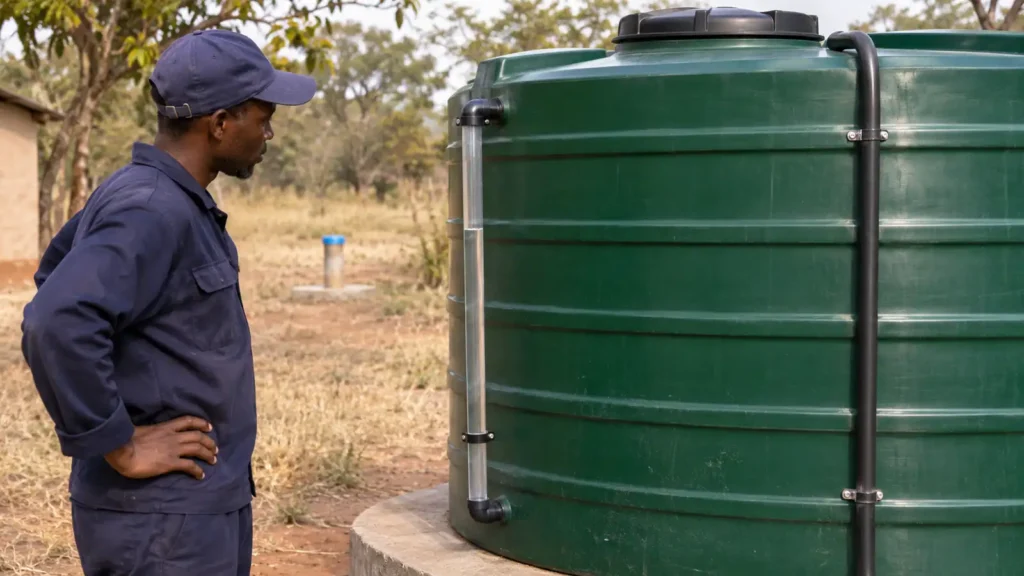
A pressure tank provides a small pressurised buffer. A large vented storage tank serves a different purpose: holding bulk water for later use. If your goal is several hours of water during an outage, specify that storage requirement separately; the pressure vessel’s nominal litres are not a dependable backup supply figure.
Check how your pump is controlled first
The calculation below applies to a fixed-speed pump controlled by a pressure switch, filling a precharged tank between two pressure settings.
A variable-speed constant-pressure system needs the tank size, precharge and operating arrangement specified for its drive and pump. For example, the Pentair Pentek manual gives separate tank requirements for its Intellidrive system. An electronic pressure-and-flow controller may have another set of requirements. Identify the controller before applying a pressure-switch sizing rule.
For an existing installation, read the controller’s model from its accessible label or paperwork. A controller that looks similar to a pressure switch is not enough to establish how it stops the pump. The QDD constant-pressure booster requirements page helps frame the wider pump-and-control enquiry.
Turn the minimum running time into required drawdown
Start with two inputs: the pump’s delivered flow while refilling the tank, and the minimum run time required by the pump, motor and control equipment. Do not take the flow from the pump’s maximum-flow headline, and do not substitute the flow from one open tap.
The Pentair WellMate sizing method links pump delivery with minimum run time. For a simplified constant-flow refill with the outlets closed:
Required drawdown (L) = pump delivery (L/min) × minimum run time (min).
Consider an illustrative system delivering approximately 20 L/min over its refill pressure range, with an equipment requirement of 1 minute per run. It needs at least 20 L of drawdown. The one-minute requirement is an assumption for this example, not a setting for every pump.
Actual pump delivery usually changes as tank pressure rises. Ask the installer to use the pump curve over the whole refill range. Using the highest verified delivery in that range is a conservative way to check the minimum refill time. The permitted number of starts must also be checked against the motor and controller instructions; meeting one run-time target does not settle every operating limit.
Read the drawdown column before choosing the tank
The Davis & Shirtliff Global Water pressure-tank table gives these entries at 2.5 bar cut-in and 4 bar cut-out, with the specified precharge. All pressures here are gauge pressures. These third-party examples are not QDD model specifications.
| Published tank entry | Drawdown at 2.5 / 4 bar |
|---|---|
| GWS 60 L | 17 L |
| GWS 100 L | 28 L |
For the assumed 20 L/min refill, the 60 L tank gives 17 ÷ 20 = 0.85 minutes, or 51 seconds. It falls short of the example’s one-minute requirement. The 100 L tank gives 28 ÷ 20 = 1.4 minutes, or 84 seconds, so it passes this initial check.
That makes the 100 L tank a candidate, subject to pressure rating, water suitability, connections, installation space and equipment requirements. It does not turn it into a universal choice for every 20 L/min pump.

Those 84 seconds describe pump refill time with no water being used, not how long a shower will run. While the pump is off, drawdown is consumed at the outlet demand. When the pump is on and a tap remains open, some pump flow goes directly to that tap, leaving less to refill the tank. The pump may run continuously if demand matches its delivery.
Keep pressure settings and precharge with the calculation
Drawdown is tied to a particular pressure range and precharge. A table value from a different pressure column is not interchangeable, even when the tank has the same total volume.
Precharge is the air pressure checked with the water side emptied and depressurised. A reading taken while the vessel contains pressurised water does not establish the correct empty-tank precharge. Have the installer isolate the pump and follow the vessel’s instructions for this check; do not open electrical covers or dismantle the pressure vessel to gather sizing information.
For the example above, the GWS installation manual specifies precharge 0.2 bar below cut-in for pressure-switch systems with a pressure difference up to 2 bar. That gives 2.3 bar here. Other equipment and control methods can specify different relationships, so do not automatically copy a factory charge or another installation’s setting.
Do not raise cut-out pressure just to obtain more drawdown. The pump must reach the stopping pressure under the actual supply conditions, and the tank, fittings and pipework must remain within their pressure limits. The low end of the pressure range must still meet the needs of the outlets. Tank size cannot compensate for a pump that cannot produce the required pressure.
Replacing a tank: check what changed
If an existing system used to run normally and now starts every few seconds, its original nominal capacity may not be the problem. Lost air charge, a damaged membrane, a leak or a control fault can change the cycling behaviour. Replacing it with a larger vessel without identifying the cause can leave the fault unresolved.
Tell the installer whether the rapid starts happen while water is being used or when all outlets are closed, whether this is new, and whether anyone recently changed the pump, controller or pressure settings. These observations help separate a sizing question from a maintenance problem. Do not keep forcing repeated starts to collect a longer record.
For a new tank selection, ask for the following to appear together in the recommendation:
- The pump and controller models, with the actual control method.
- The proposed cut-in, cut-out and manufacturer-specified precharge.
- The pump delivery across that pressure range, minimum run time and allowable starts.
- The chosen tank’s drawdown at those conditions, plus its pressure rating, water suitability and connection size.
Before handover, ask the installer to verify the actual switching pressures, the refill run time with outlets closed, and the pressure at the outlets under the agreed water demand. Compare those results with the equipment requirements and the reason you bought the tank. The useful outcome is adequate pump running time and satisfactory water delivery, backed by a matching drawdown figure.