
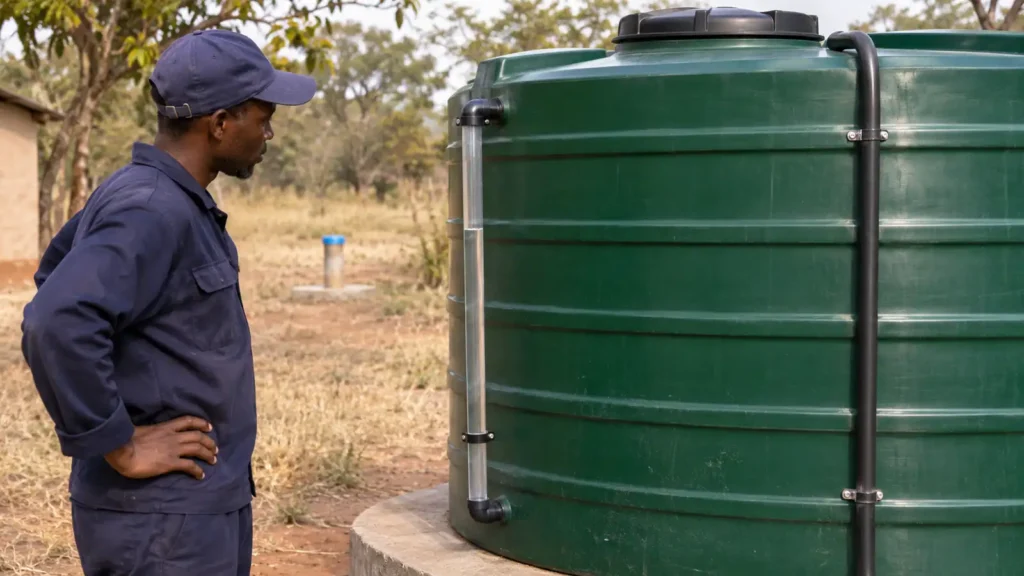
Choose a low-yield borehole pump that can refill a storage tank at the rate and schedule recommended in the pumping test report. Then size the tank to cover the hours when demand exceeds that refill rate. Check the total water available each day first. If daily supply falls short of daily use, storage can delay the shortage. A larger pump can draw down the water level faster, so the pumping rate still needs to fit the borehole’s capacity.
Read the pumping test and recovery records together
Look for the measured pumping rate, the duration of the test and the water levels recorded at different times. The resting water level gives a starting point. The pumping water level is the depth to water while the pump runs at a stated rate. The drop from the resting level is the drawdown. The recovery record shows how the level rose after pumping stopped. Ask the test provider to translate those records into a recommended abstraction rate, pumping and rest intervals, and the expected range of pumping water levels. A brief high flow can include water already stored inside the borehole. South Africa DWS groundwater assessment guidance. USGS study of low-yield wells.
Ask whether the test represents the dry season and whether the site has an applicable abstraction limit. If the supply has recently declined, bring earlier test results and measured flow to the person assessing the borehole. A low flow at the tap alone leaves the borehole, pump and pipework to be checked.
Match the pump to the recommended refill rate
Use the recommended rate as the target flow when selecting the pump. Work out the total dynamic head (TDH) to the tank at that flow. Include the lift from the pumping water level to the delivery point, the losses in the pipe and any pressure required at delivery. Check the pump curve across the expected water levels so the pump can reach the tank at the deeper water level and stay within the recommended rate when the water level is higher. Confirm the proposed flow control, pump operating range and installation depth with the supplier. QDD guide to total dynamic head.
Keep the borehole recovery schedule in the control plan. A low water cutoff protects the pump if the level drops too far. A separate tank level control stops refill when the tank reaches its upper level. Give the installer the recommended rest intervals and have them confirm how the system will allow a restart. QDD guide to borehole pump dry run protection.
Check the daily water balance
Suppose a test provider recommends 0.5 m³/h and a pumping and recovery schedule that allows up to 8 total hours of pumping per day. At that rate the borehole pump could deliver 4 m³ per day if all eight hours were available and the tank could receive the water. A site using 3 m³ per day would need six actual pumping hours at that rate. These numbers are assumptions for the example. Plan those six hours within the permitted pumping windows and check how power outages or seasonal changes could shorten the available time.
If the reliable daily refill is below demand, review the demand or arrange another water source. A tank can carry water between hours or days, provided enough surplus is available to refill it over the planned cycle.
Size usable storage for the peak and the rest periods
In the same example, suppose the site uses water at a steady 0.8 m³/h for two hours, for a total of 1.6 m³. Start both comparisons with the same amount of water in the tank. Count on continuous refill for those two hours only if the recommended schedule allows it.
| Borehole pump during the two-hour peak | Water drawn from storage |
|---|---|
| Runs at 0.5 m³/h throughout the peak | 1.6 m³ used minus 1.0 m³ refilled = 0.6 m³ |
| Rests throughout the peak | 1.6 m³ used with no refill = 1.6 m³ |
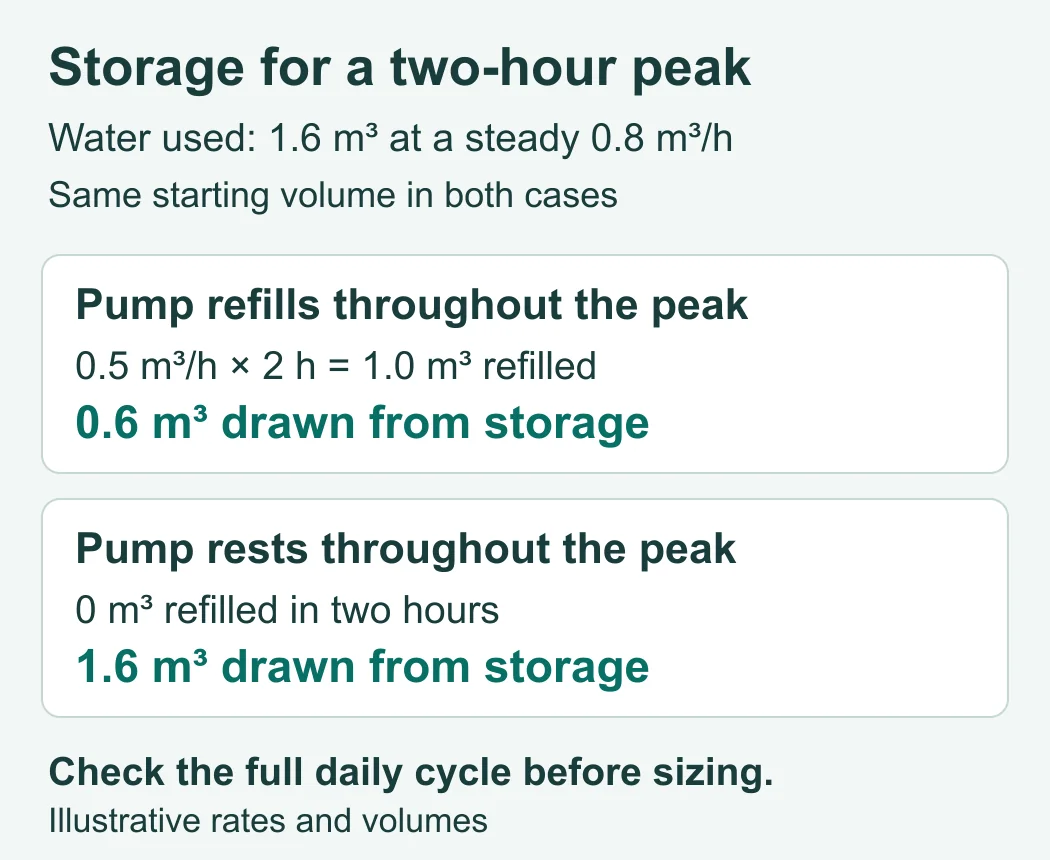
For the actual site, list expected water use and refill in hourly or shorter intervals. Starting at the normal full level, subtract the water used and add the refill in each interval, up to the tank’s usable limit. Find the lowest balance and check that the tank recovers before the pattern repeats. Include the periods when the pump rests or power is unavailable. The two-hour example is one part of that balance. Penn State Extension guide to low-yield wells.
Ask for the volume between the tank’s normal full level and the minimum usable level at the outlet or booster. Deduct any reserve you want to keep available for interruptions. The remaining volume is what you can count on for normal peaks.
Give the well pump and the outlet their own duties
Let the borehole pump replenish the tank at the recommended rate. The tank can then supply short periods of higher demand. Check the available gravity pressure at the outlet. Where a booster is needed, size it for the peak flow and pressure required after the tank, and include a low tank level cutoff. QDD tank filling applications.
For a pump selection enquiry, send the pumping test and recovery records, the recommended rate and schedule, the tank inlet elevation and pipe route, and the daily and peak water use. Ask for the proposed pump duty, the usable tank volume and the refill time. QDD pump selection help.

