
Motor size alone does not tell you a borehole pump’s monthly electricity cost. Start with actual electrical input power and the hours the pump runs. If a dedicated meter already records the pump circuit’s energy use, you can work directly from its kWh readings.
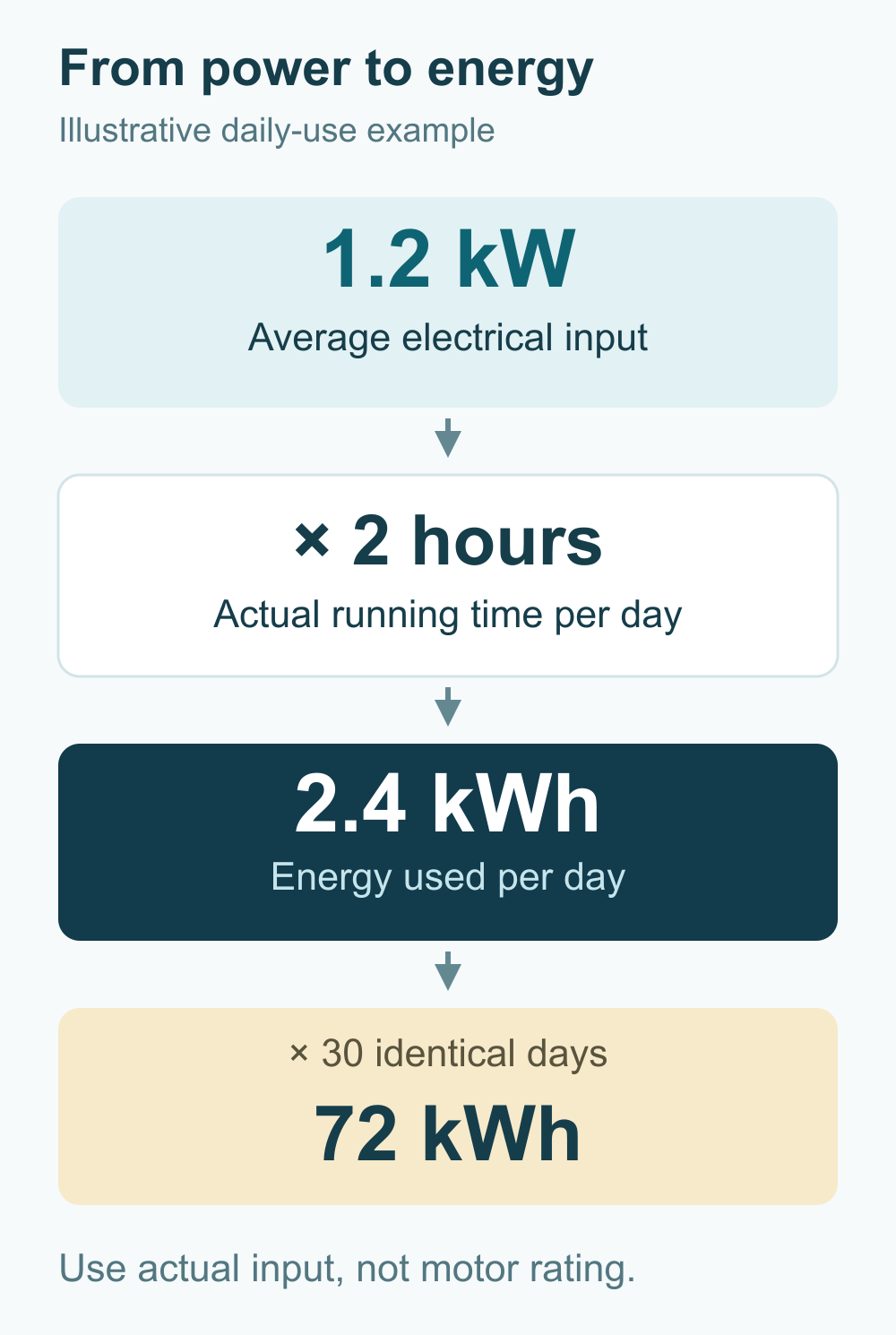
For example, an average input of 1.2 kW over two running hours uses 2.4 kWh. Below, we turn that into a monthly cost, show where to find your own numbers and explain what to look at if the bill has risen.
Calculate the electricity first, then the cost
Energy used (kWh) = average electrical input (kW) × running time (hours).
kW describes how fast electricity is being used; kWh measures how much is used over time. A 1 kW load running for one hour uses 1 kWh. The US Energy Information Administration explains the distinction.
Here is an illustrative budget, not a typical household figure or a QDD pump specification:
- Average electrical input while running: 1.2 kW.
- Actual running time: 2 hours per day.
- Days with the same use: 30.
- Example energy rate: R3.00 per kWh. This is an assumed rate for the calculation, not a current tariff quotation.
The pump uses 1.2 × 2 = 2.4 kWh per day, or 72 kWh over 30 days. At the example rate, the energy charge is R7.20 per day, or R216 for the month. One running hour costs R3.60 under those assumptions.
This calculation covers the stated running load. Add any relevant standby or auxiliary energy that it excludes. A circuit meter that already includes those loads over the full period needs no separate addition for them. The amount added to a complete electricity bill also depends on the applicable tariff and other charges.
Which power figure should you use?
A motor’s rated kW is not necessarily its electrical input
A motor may be described as 0.75 kW, 1.1 kW or a certain horsepower. Those figures often describe its rated mechanical output, rather than the electricity it takes from the supply at your operating condition.
In common pump documentation, P1 means electrical input and P2 means motor shaft output. Read the manufacturer’s definitions: a stated P1 can still be a rated or maximum value, not today’s measured input. Grundfos illustrates these power boundaries.
If you have a documented average input for the actual duty, use it. If you have a meter showing cumulative kWh for the right circuit, use the change in that reading instead. For a variable-speed pump, one momentary kW reading may not represent the whole filling cycle.
Only have a nameplate photo? That is enough to start an enquiry. Send the pump or motor details and any controller model you can identify, then ask: “Is this figure motor output or electrical input, and what information do you need to estimate my system’s electricity use?” Do not fill the gap with a guessed efficiency percentage.
Amps alone will not give a reliable energy cost. AC real power also depends on power factor and the electrical arrangement. For hardwired pumps, suitable measurement is a job for a qualified electrician; there is no need to open a control box to follow this guide. The US Department of Energy motor guide explains input-power measurement and operating-hour assessment.
Count running hours, not hours with the switch on
A system can remain powered all day while its motor starts only to refill a tank or meet demand. Conversely, unexpected water use or a control problem can make it run much longer than you think.
Use an existing run-hour counter or controller log if available. Otherwise, note the duration of normal filling cycles and how many occur during a representative day. Make sure the indication means the motor is running, rather than just that the controller has power. Treat a short observation as an estimate, especially when irrigation or household demand changes.
Several cycles add together: four 30-minute runs equal two running hours. You do not need to force a test run or leave the pump operating without demand to obtain a budget estimate.
What does your electricity meter actually include?
A useful meter reading needs a clear boundary. Does it cover the borehole pump and controller, the whole water system, or the entire property?
For a dedicated circuit meter, subtract the earlier cumulative kWh reading from the later one. 320.8 − 318.4 = 2.4 kWh, for example. These are illustrative readings; use the units and multiplier on the actual meter. Record the dates and what equipment the circuit supplies.
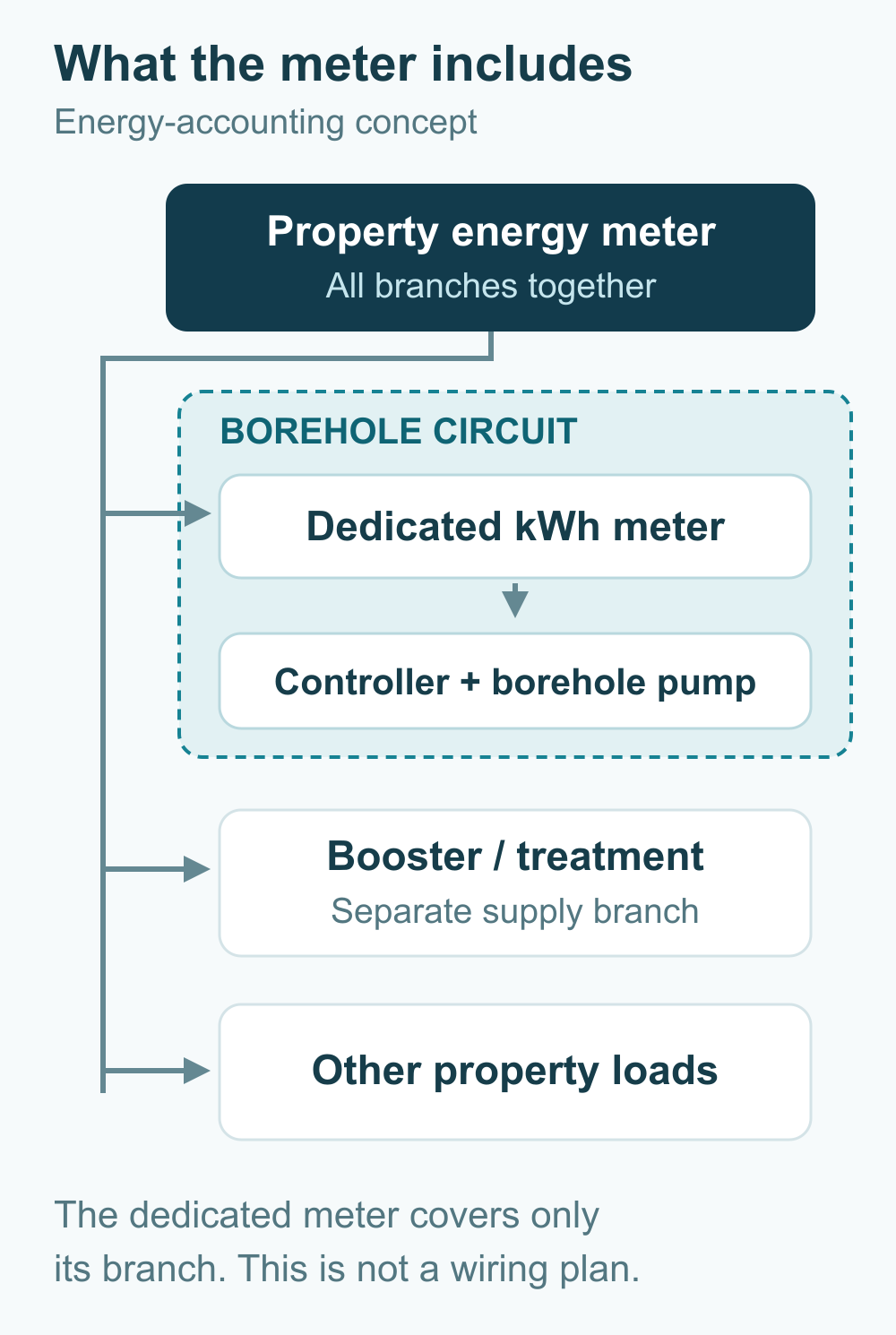
If the borehole fills a storage tank and another pump supplies the house, the booster has its own energy use. UV treatment or other equipment may add more. A meter serving only the borehole circuit will not capture those separate loads. A whole-property meter includes them, but also includes appliances unrelated to water supply.
No dedicated meter? Start with the bill, any existing controller records and a rough account of normal running time. If the decision involves a costly replacement or a disputed shared-well bill, ask an electrician about suitable circuit energy monitoring. For a small budget estimate, a documented input figure and a clearly labelled runtime estimate may be sufficient.
Use the rate that applies to those extra kWh
Find the energy charge on your current tariff or bill. For South African customers, use the tariff of the actual electricity supplier: an Eskom direct customer and a municipal customer may have different terms. Eskom’s tariffs and charges page provides an official starting point for its own supply tariffs.
For a single energy rate, multiply the pump’s kWh by that rate. If rates change by time of day, split the use across those periods. If additional use crosses a tariff block, apply the relevant rate to each portion.
Avoid dividing the entire bill by total kWh and assuming that is the price of every extra unit. Fixed charges may remain unchanged, while demand or capacity charges can follow separate rules. Check whether the rate includes tax and applicable additions. Keep your answer labelled as an energy charge estimate unless you have accounted for the full bill structure.
Compare energy for the water actually delivered
When comparing pumps or tracking a system over time, the monthly cost can hide changes in water use. One cubic metre (m³) is 1,000 litres, or one kilolitre (kL). A useful additional measure is:
Energy per cubic metre = kWh used ÷ m³ delivered during the same period.
If the example system uses 2.4 kWh to deliver 3 m³, it uses 0.8 kWh/m³. At the illustrative R3.00/kWh rate, that is R2.40 per m³ for electricity. It excludes the cost of drilling, equipment, maintenance and any unmetered treatment or boosting.
Use measured delivered water where available. A tank’s nominal capacity is not proof of how much entered it, especially if water was being drawn out during filling. DOE’s water-energy guidance describes energy intensity as energy per unit of water.
There is no universal “good” kWh/m³ figure for every borehole. Compare similar delivery height, pressure and water volume, with the same equipment included. A deeper pumping water level changes the job the pump has to do.
Likewise, a smaller kW number does not guarantee lower energy use. In a hypothetical comparison delivering the same water under the same required conditions, 1.2 kW for two hours uses 2.4 kWh; 0.9 kW for three hours uses 2.7 kWh. The lower-power option uses more energy in that example. Actual performance must come from the relevant pump data or measurements.
The bill went up: where should you look first?
Start with the bill itself. Did the kWh increase, or mainly the price? Compare billing dates and kWh per day, and note whether the readings were actual or estimated. A longer billing period or a new tariff can increase the amount without a pump fault.
If electricity use did rise, consider what changed: more irrigation, extra occupants, longer filling cycles or another new appliance. Whole-property consumption cannot identify the pump as the cause on its own.
When water demand seems unchanged but the pump runs more often or takes longer to refill the same amount, that is a useful symptom to investigate. Note when it happens and whether water still reaches the tank. Use the guide for a pump running without delivering water or for low pressure in a borehole and tank system if either matches what you see.
A helpful first message to your installer is: “The bill’s kWh per day has increased. Our usual water use seems similar, but the tank now takes longer to refill. Here are the controller details and the dates I noticed the change.” Add readings you already have; an incomplete record is still useful. The next step is to establish what changed, rather than buy a replacement from the bill alone.
Choosing a new pump with running cost in mind
Ask suppliers to compare electrical input at the flow and head your system needs. A pump curve shows performance across operating points; maximum flow and maximum head are not one usable duty point. A power curve may show shaft power rather than supply input, so ask what its label means and whether the motor and drive losses are included.
Give the supplier the required water delivery and the site information you have. The borehole pump sizing guide helps identify the missing flow, head and yield inputs. Ask for the expected input power and filling time at the proposed duty, not just a smaller motor rating.
Reducing avoidable water demand or unnecessary pumping can help. Changing speed or pressure needs a system assessment: a borehole with substantial static lift may not deliver the required water at a lower speed. The DOE pumping-system guide explains why variable-speed savings depend on the system. Keep the required water delivery in the comparison.
Two common follow-up questions
Does starting the pump make the electricity estimate much higher?
Starting behaviour matters for the supply and controller, but a starting-current multiplier is not a multiplier for every operating hour. A suitable meter over complete cycles captures the energy within its measurement boundary. Frequent cycling deserves investigation; the cost depends on the actual cycle, not a universal startup percentage. A monthly kWh estimate also does not establish whether a generator or inverter can start the pump.
Would solar pumping remove this cost?
Solar can replace some grid electricity used for pumping. The pump still needs energy, and the result depends on available sunlight, equipment compatibility, water demand and storage. Grundfos explains the role of water storage in solar pumping.
Use the grid energy you could actually displace to estimate savings. Do not assume the whole property’s bill or its fixed charges will disappear. Establishing your current kWh and water delivery gives you a better starting point for comparing any alternative.