If your water pump keeps turning on and off, notice when it happens before buying a replacement part. Does it start when nobody is using water, keep stopping while a tap is open, or cycle while filling a storage tank? Each pattern points to a different set of checks.
Starting when you open a tap can be normal. Repeated brief runs, a new change in behaviour, or pulsing water at the shower deserve attention. An alarm followed by a delayed restart is another clue: the controller may be retrying after a fault rather than responding to ordinary water demand.
This guide covers clean-water borehole and household supply systems. There is no single safe number of starts per hour for every pump; the motor and controller requirements matter.
First, identify which pump is cycling
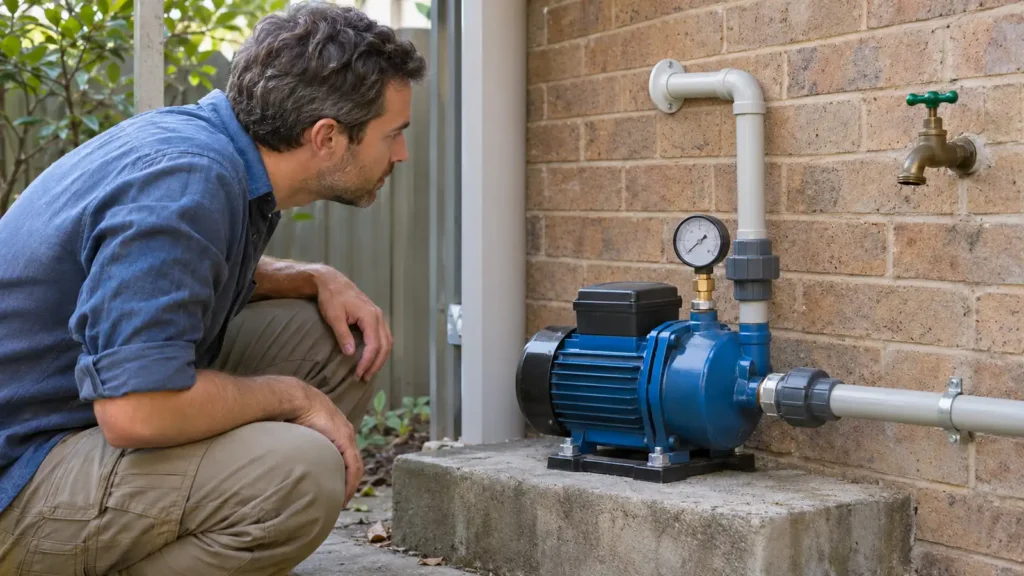
A property with a borehole and a storage tank may have two pumps: one fills the tank, and another boosts water from the tank to the house. Find out which one actually stops and restarts. The location of the sound and an existing external run indicator may help; a controller power light alone does not prove the motor is running.
Also distinguish the two kinds of tank. A large, vented storage tank holds your water supply. A pressure tank is a closed vessel connected to the pressurised pipework; its air cushion helps supply water between pump starts. Having a storage tank does not mean the system has a pressure tank.
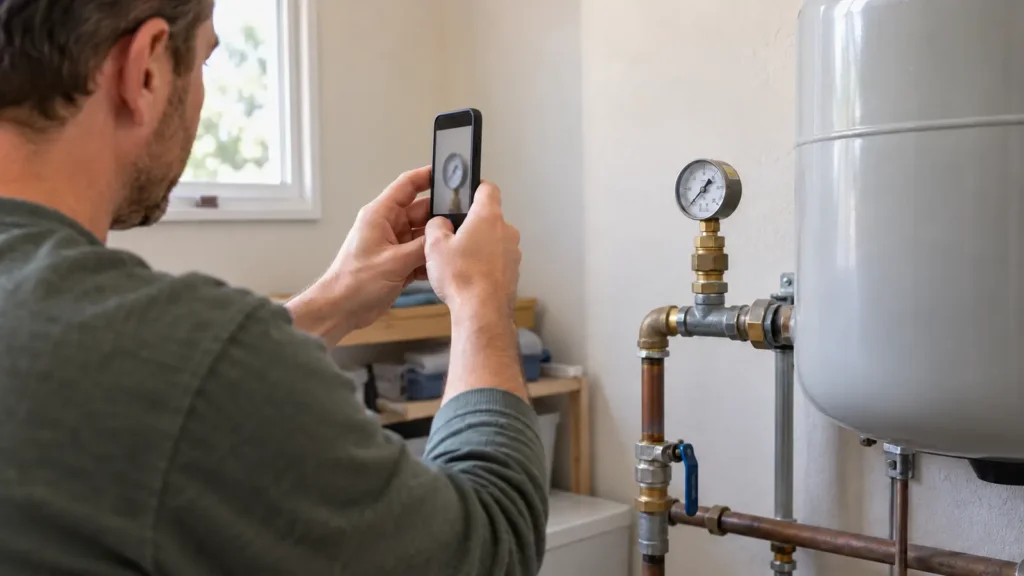
If you do not know the equipment names, a photo of the visible arrangement and controller label is enough to begin a conversation with the installer. Leave electrical covers closed.
It starts again when no one is using water
First look for water use that is easy to miss: a toilet cistern still refilling, an irrigation timer, a washing machine, a filter backwash or another tank being topped up. “Nobody opened a tap” is useful information, but it does not always mean flow has stopped.
If an existing pressure gauge is safely visible, note whether pressure drops after the pump stops and before it starts again. Do not leave a rapidly cycling pump running just to collect a longer recording.
With water use genuinely stopped, falling pressure can suggest a leak in the system or water returning through a valve that should prevent backflow. It does not identify the faulty part. A hidden pipe leak and a leaking non-return valve can require different repairs; fitting another valve without locating the loss can hide the problem. The Grundfos PM 1/PM 2 troubleshooting instructions include leakage and control-specific tank checks among the causes of frequent starts.
The next useful step: tell the installer whether pressure falls while the pump is off and whether you found any automatic water use. Ask them to locate the loss and check the control response. Pipework isolation tests need someone who understands the system; do not experiment by closing valves and running the pump against them.
It keeps stopping while a tap stays open
Think about the use that triggers it. Is it only a trickling tap or a toilet nearing the end of its refill, or does it also happen during a normal shower? That distinction helps the installer reproduce the problem. If you have already noticed that cycling disappears at a higher flow, mention it; leaving extra water running is not a fix.
With a pressure switch and pressure tank
Some cycling during continued water use is normal in this arrangement. The tank supplies water while the pump is off. Pressure falls to the switch’s start setting; the pump then runs. If it delivers more than the outlet is using, it replenishes the tank and can reach the stop setting.
The useful quantity is drawdown: water the tank delivers between those stop and start pressures. It is smaller than the tank’s total volume and changes with the pressure settings. A 20-litre vessel does not provide 20 litres before every restart. Amtrol’s tank sizing data lists tank volume and drawdown separately.

If the runs have become much shorter, ask the installer to check usable drawdown, actual start and stop pressures, tank condition and precharge under the manufacturer’s test conditions. A running-system gauge reading is not an empty-tank precharge reading.
Avoid simply adding air to an old tank. Amtrol’s installation instructions require professional precharge checks and warn about re-pressurising tanks with signs of deterioration. Correct tank size alone cannot rule out a damaged diaphragm, a connection problem or unsuitable controls.
With an electronic pressure/flow controller
Many of these controllers start on a pressure drop and stop when flow ends, rather than working like a conventional pressure switch with fixed start and stop pressures. Model and mode matter: some arrangements use an external tank, and very small flows may interact with the controller’s detection limits. Grundfos’ pressure-control product guide illustrates these different operating modes.
Give the installer the controller model and the outlet that triggers the cycling. They can check flow detection, the selected mode and any tank requirement. Buying a larger pressure vessel before identifying the controller may miss the cause.
With a variable-speed controller
A changing motor sound may simply be the drive adjusting speed as water demand changes. It is not necessarily stopping and starting.
If the motor really stops repeatedly, or pressure swings badly, record the existing display or fault message. Sensor feedback, settings, tank requirements and the water supply need checking together. Franklin’s SubDrive troubleshooting manual treats these as system checks; a mechanical pressure-switch adjustment is not a universal solution for a variable-speed system.
If the motor stays running but flow is weak, use the borehole pump low-pressure guide instead of treating every pressure fluctuation as short cycling.
It cycles while filling a storage tank
For a pump controlled by tank level, ask whether the repeated starts occur near one particular water level. In a typical filling arrangement, the pump starts at a lower level and stops at an upper level. The separation lets it complete a useful fill rather than switch back and forth around one point.
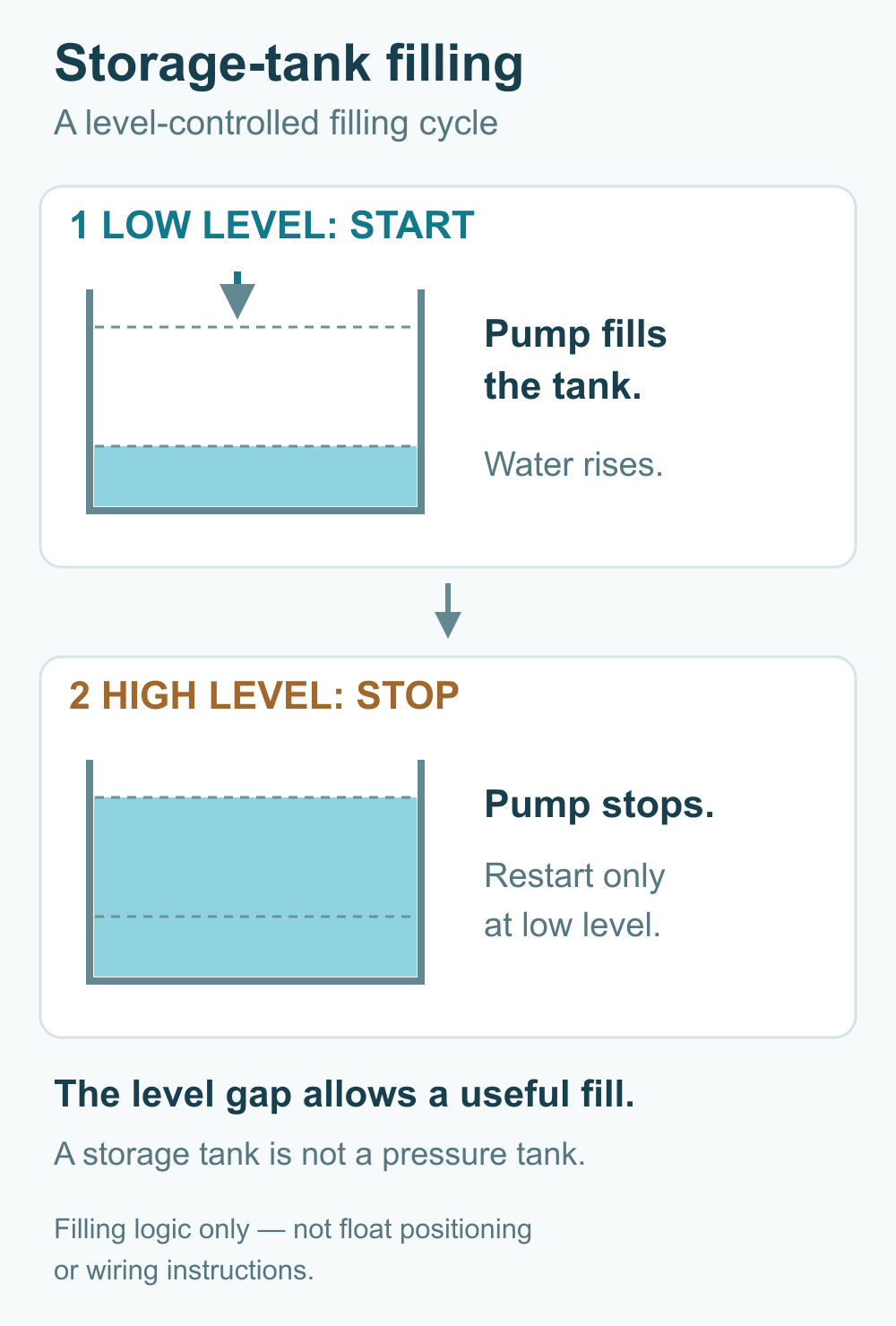
A float moving with disturbed water, a restricted float or an unsuitable start/stop arrangement can cause repeated signals. The installer should check the actual level range, float movement and control logic. Franklin’s Pumptec owner’s manual specifically includes a bobbing float among rapid-cycling causes.
There is another arrangement worth recognising: a pump may supply a tank through a mechanical float valve that gradually closes as the tank fills. If the pump responds to pressure or flow, that shrinking flow can affect its operation. That is different from an electrical level switch sending a fill request to the pump controls. Describe which arrangement you have before assuming it needs a pressure tank.
Our tank-filling application overview explains the wider supply task. For an existing fault, start with the installed control arrangement and the level at which the behaviour changes.
It stops with an alarm, then tries again
A delayed retry may be part of a protection function. Capture the existing fault indication, controller model and what happened to the water supply. Dry-running detection, electrical faults and other protection events need their own diagnosis; repeated resets can conceal the useful fault information.
For example, Grundfos’ SCALA1 alarm guidance distinguishes leakage-related cycling from dry-running and other alarms. The meaning of a light or code belongs to the actual model, not to pumps generally.
If there is no delivered water, the pump-running-but-no-water guide helps organise the water-side observations. Repeated breaker trips, damaged cables or a burning smell call for stopping use and arranging qualified electrical or pump service. Do not wiggle cables or bypass a protection device to keep it running.
What to send the installer—and what to check after repair
You can start with a short note; missing pressure readings need not delay the enquiry:
- Which pump: borehole-to-tank, tank-to-house, or unknown; include an accessible exterior photo.
- When it happens: no known water use, one outlet open, ordinary shower demand, or tank nearly full.
- What you observe: brief repeated runs, pressure change on an existing gauge, or a fault indication followed by a pause.
- What changed: new installation, recent tank/controller work, or previously normal operation that has changed.
An existing short video may help if it shows the display and sound with the water-use situation explained. There is no need to recreate an alarming fault to obtain one.
After repair, have the installer verify the system under the use that caused the complaint: the same shower, low-flow outlet or tank-fill cycle. Check that automatic stopping and restarting work as intended and that the original unexplained cycling has gone. Clearing an alarm or seeing the motor run once is not the whole result.
If replacement controls are recommended, compare their requirements with the existing pump, tank and supply. QDD’s drives and controls range is a starting point for an equipment enquiry once the required control method is clear.