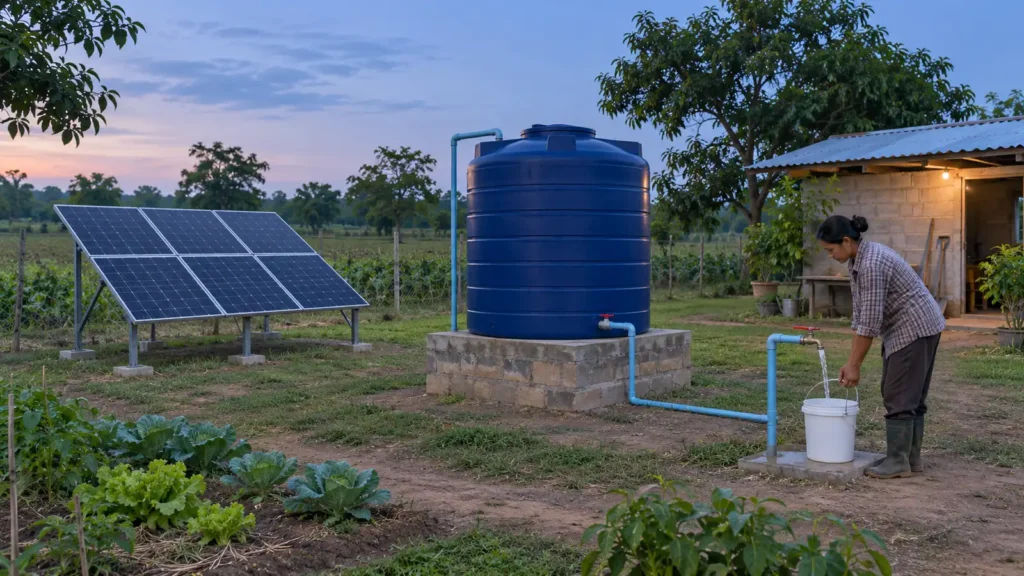

Your borehole pump still works. You would like to use solar power, but replacing a serviceable pump feels wasteful. Can you keep it and change how it is powered?
A compatible existing AC borehole pump can be converted to solar operation. The decision depends on the motor, its controls, the condition of the installation and the water you need—not just the kW printed on the pump label.
Start with one practical question: can the pump fill a tank during the day, or must it deliver water whenever you open a tap? That answer helps separate two different routes to solar power.
Two ways to power the pump with solar
Route 1: a dedicated solar pump drive
In this arrangement, a suitable solar pump drive takes DC power from the panels and supplies the AC output required by a compatible motor. It manages the motor and available solar power together. The existing pump may stay in the borehole if the full combination is approved and still meets the water requirement.
This route is worth considering when daytime pumping can refill storage. As sunlight changes, the drive may change pump speed or stop until operating conditions recover. A normal AC variable-frequency drive is not automatically suitable for direct PV input: the proposed unit needs the required solar-input and motor-control capabilities.
Grundfos GO Solar, for example, pairs its solar-drive solution with applicable AC pumps and assesses the application. That is evidence that retaining an AC pump is possible, not approval for every pump and drive combination.
Route 2: supply the existing pump from a suitable AC power system
You may already have solar power for the house or farm. In that case, the task may be to supply the pump through a compatible AC circuit and its normal controls, rather than install a separate direct-solar pump drive.
Check the supply voltage, phase and frequency, the pump’s starting demand, continuous load and other appliances running at the same time. Battery capacity and permitted battery output also matter if the pump must run from storage. A large headline inverter rating alone does not settle those questions. Victron’s inverter operating guidance explains how motor or pump starting demand can exceed an inverter’s current limit.
Also confirm whether the pump’s actual circuit is supplied during a grid outage. Having rooftop panels does not by itself provide backup power. The system needs the appropriate backup capability and configuration.

These routes have different design checks. A dedicated pump drive follows its motor-control requirements; a house or farm inverter must support the pump as an AC load. Neither route lets you connect solar panels directly to an ordinary AC motor.
Will your particular motor work with the proposed drive?
Ask for a compatibility check against the full motor model. Useful fields include phase, voltage, rated current, power, frequency and motor type. The installer also needs the existing controller or starter details and the downhole cable information.
If it is a three-phase motor
Three-phase does not mean universally compatible. Confirm that the motor is suitable for the proposed drive, its operating speed range and the installation’s cooling conditions. Drive output voltage and current must suit the motor; the supply requirements on the input side are a separate check.
If it is a single-phase motor
Do not assume you must replace it, but do not buy a standard three-phase-output drive for it either. Single-phase motors can have different starting and capacitor arrangements, and support varies between drive models.
The Franklin Drive-Tech MINI and COMPACT Solar manual lists supported motor types with model-specific limits, including certain single-phase designs. The useful question is therefore: “Does this exact drive support my exact motor and starting arrangement?” A drive accepting a single-phase supply does not necessarily provide a single-phase motor output.
Your existing control box may need to remain, change or be replaced as part of the approved solution. Have the supplier state this explicitly. Capacitors, starters and protection devices are not items to remove by guesswork.
If the motor label is down the borehole, start with the installation invoice, pump record or previous supplier. A photo of an accessible controller label is useful, but it may not identify the motor. The installer can help recover the missing information before deciding whether any equipment needs lifting.

Is the old pump worth keeping?
A pump that currently delivers the required water, has identifiable equipment and has a sound installation is a reasonable candidate for assessment. Keeping it may avoid unnecessary replacement work, but that saving needs to be compared with the complete retrofit cost.
If output has fallen, the pump trips, the cable has a known problem or repairs are overdue, investigate those issues first. Changing the power source does not repair a worn pump or increase the yield of the borehole.
Ask the installer to establish the present delivered flow, pumping water level and operating condition. Then check whether that pump can still meet the intended duty. Our guide to reading a pump curve explains why flow and head must be considered together.
There are three useful outcomes from this review: retain the pump with matched controls; repair the existing installation before conversion; or compare replacement with a complete matched pumping system. The cheapest control box is not necessarily the cheapest way to deliver the required water.
Design for the water you need across the day
The existing pump may fill your tank quickly on grid power. That does not mean it will produce the same flow throughout a solar-powered day.
With a direct-solar variable-speed arrangement, lower available power can mean lower speed. The pump must still develop enough head to lift water through the actual system. In a high-lift installation, it may turn at a low speed yet deliver little or no water to the tank. Its approved operating range and motor cooling requirements still apply.
Ask for an estimate of daily delivered water at your site and duty, including the relevant season, shading and source limitations. Multiplying a catalogue maximum flow by a fixed number of “sunshine hours” is not a reliable substitute.
A tank can separate pumping time from use time
Suppose you mainly need water for evening garden use and the pump can replenish a tank during daylight. Storage may reduce the need to keep that borehole pump running after sunset. It does not make the stored water unlimited, and it does not automatically provide adequate outlet pressure.
A tank above the use point may supply a suitable low-pressure task by gravity. Other applications need a separate booster, with its own power requirement. Include that downstream use when describing the retrofit.

If you need the borehole pump itself to operate at night, state that at the beginning. The design then needs an appropriate available power source and operating arrangement; a larger daytime panel array alone does not provide night-time electricity.
What else belongs in the conversion quote?
The array must fit the drive electrically
Panel wattage is only part of the match. The designer must check the drive’s DC voltage and current limits, its working or MPPT voltage range, and the array’s behaviour at the site’s temperatures. Cold conditions can increase open-circuit voltage; hot conditions can reduce operating voltage.
For that reason, there is no universal panel count or “pump kW × a fixed multiplier” that confirms a safe, useful installation. Existing panels also need checking before reuse. The array configuration and electrical installation belong with the qualified designer and installer.
Existing protection and backup need a clear plan
Confirm how source-water protection, tank-full control, motor protection and recovery after low sunlight will operate in the new arrangement. If the installation already has a dry-run device, check its compatibility with the new drive rather than assuming it will behave unchanged. See borehole pump dry-run protection for the distinction between source sensing and motor-load detection.
Grid or generator backup must be supported by the specific equipment and a defined supply arrangement. Some products support particular AC/DC changeover or hybrid functions; others do not. The quote should identify the approved solution and its controls, not simply promise “solar plus mains.”
Ask which existing items are being retained and which are included in the price: pump and motor, drive, array and mounting, controls, required protection, cable work, storage changes and commissioning. For a savings comparison, use the present pump’s actual consumption and operating schedule; pump power consumption is a separate calculation from the motor’s nameplate kW.
Start with a short, useful enquiry
You can begin with the equipment model or records, a photo of the accessible controller label, and a description of when you need water. Mark unknown details as unknown.
A useful first message is: “I have an existing AC borehole pump and want to keep it if practical. It currently fills a storage tank. I need water in the evening, but the pump can run during daylight. Here are the pump records and controller label. Please confirm the compatible power route, expected daily water delivery and which existing equipment can remain.” Change the timing and water use to match your site.
QDD’s solar water pumping requirements page provides a starting point for that assessment. A PM-drive or general control-panel listing alone is not confirmation of PV-input capability. Ask for the proposed motor, drive and power-source combination to be confirmed in the quotation.
Common questions before converting
Do I always need batteries?
No. A suitable direct-solar pumping system can pump during available sunlight and store water for later use. Whether that suits you depends on daily volume, storage, delivery pressure and when the pump itself must operate.
Can I reuse my existing solar panels?
Possibly. Their ratings, condition, layout and electrical arrangement must match the proposed equipment. Panels already supplying a house are not automatically available as a separate DC supply for a pump drive.
Can the supplier promise compatibility from the pump’s kW alone?
No. The motor type, phase, voltage, current and control arrangement matter, together with pump condition and the water duty. A useful recommendation identifies the equipment and operating assumptions it is based on.