
Borehole pump prices depend on the required flow and head, the pump and motor configuration, and what the supplier includes. A pump-only price, a kit price and an installed-system price cover different purchases. Compare them against the same requirement before deciding which offers better value.
For an existing borehole, start with an itemised equipment quote and a separate list of site work. For a new water supply, also budget for the work outside the pump package. This guide provides a comparison checklist and a request you can send to suppliers to obtain prices for your actual installation.
What does a borehole pump price include?
Ask the seller to identify the scope in writing. Terms such as “pump set” and “complete kit” do not tell you every component supplied.
| Price description | What to confirm before comparing it |
|---|---|
| Pump end (wet end only) | The hydraulic pump assembly. Ask whether the motor is excluded and which motor it matches. |
| Pump and motor | Exact models for both, whether assembled, and any motor lead supplied. Controls and installation cable may be separate. |
| Equipment kit | Every included item, with specifications and quantities. Cable, pipework, fittings and protection can differ between kits. |
| Installed and commissioned system | Equipment plus the explicitly listed site work and startup checks. Ask about exclusions such as electrical connection, trenching, tanks or removal of old equipment. |
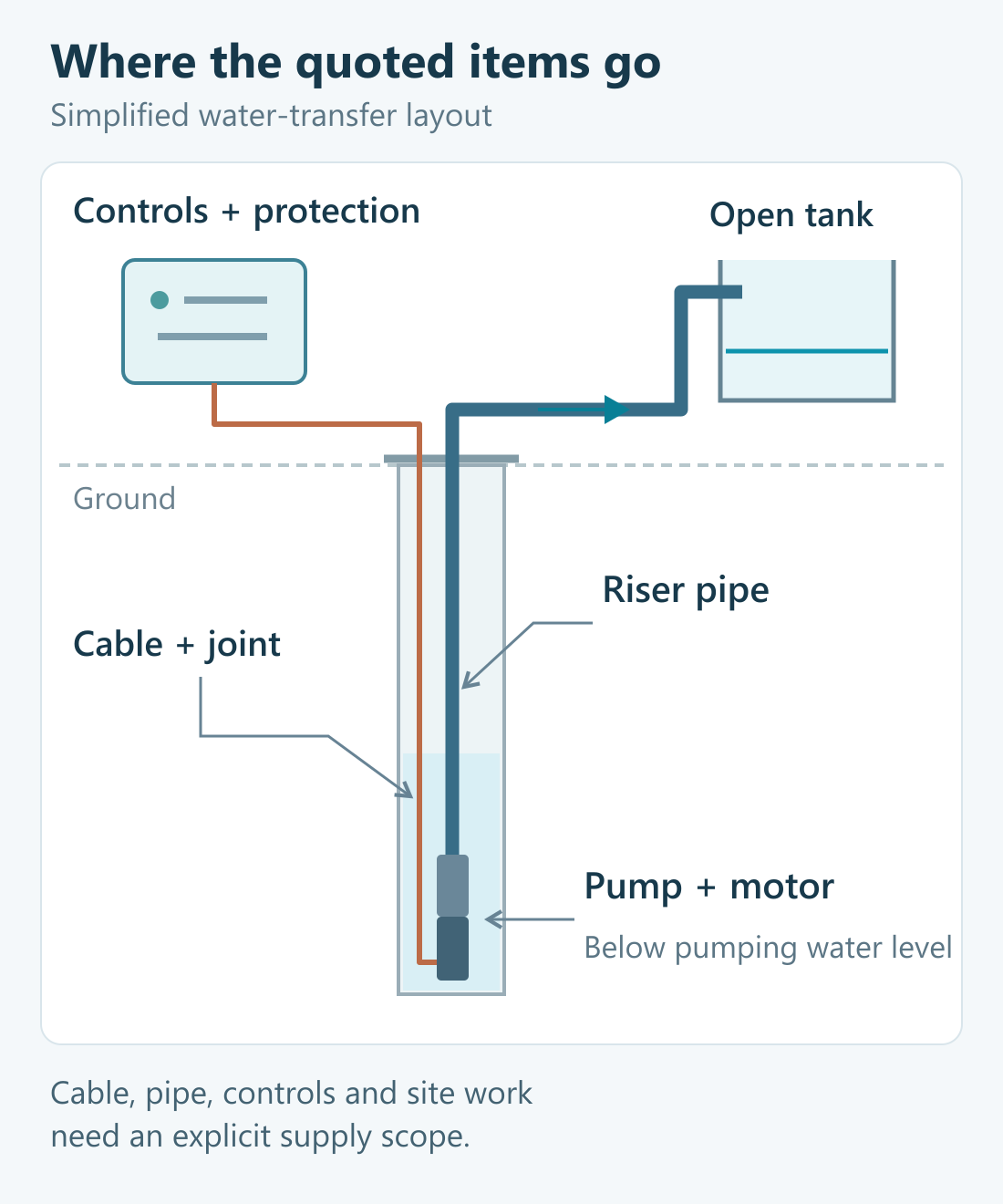
A short motor lead is not necessarily the cable needed for the full installation. Likewise, a control box in the photograph does not establish which protection functions it provides. Use the written bill of materials and the instructions for the exact model.
What changes the price of a borehole pump?
The required flow and head
Compare pumps at the same duty point: the required flow at the required total dynamic head (TDH). TDH includes elevation lift from the pumping water level, pressure required at the delivery point, and pipe and fitting losses at that flow. Grundfos explains this selection approach.
Two pumps with the same motor kW can have different hydraulic designs and operating ranges. Maximum head and maximum flow are separate limits; they do not describe one operating point. Ask for the exact model’s curve with your required point marked. Our borehole pump sizing guide explains the inputs to collect.
Buying more kW without checking the curve can increase the purchase cost without solving the water-supply requirement. A cheaper model that cannot deliver the required flow at the required head is not a suitable alternative.
Motor, power supply and control requirements
The quotation should identify the motor type, voltage, phase and frequency, together with any required starter, control box or drive. A motor with a different electrical arrangement may need different controls even when its kW rating is similar.
Ask for a list of included functions: starting, overload protection, dry-run protection, tank-level control or pressure control, as applicable. Also ask whether the sensors, probes or switches needed for those functions are supplied. “Controller included” is too vague to establish this.
For an existing installation, give the supplier the motor nameplate and the control or drive model. A permanent magnet motor needs a compatible drive; an ordinary starter or a generic inverter should not be assumed suitable. See QDD’s pump drives and controls when preparing this part of the enquiry.
Cable, riser pipe and installation accessories
These items can change the total substantially, especially when the installation is deep or the control point is far from the borehole. Ask for the cable’s complete route length, conductor size and specification, including the route above ground. Cable selection should follow the applicable motor or drive instructions and installation conditions; Franklin Electric’s AIM resources provide manufacturer guidance for its equipment.
For the riser pipe, record length, inside diameter, material and pressure rating. Specify the couplings, joint kit, wellhead fittings and valves required for the proposed arrangement. A cable length in a kit description does not prove that the kit suits a borehole of the same depth.
Construction and water conditions
Identify the materials and limits for the quoted model, rather than relying on a broad label such as “stainless steel pump”. Ask which parts that contact the water use which materials, and whether the model suits the available water-quality information, sand content and temperature.
The useful comparison is between suitable, documented configurations. A different construction may change the price, but a higher price alone does not prove better suitability or longer service life.
Use this checklist to compare two quotations
First choose one comparison scope: equipment delivered to the agreed destination, or an installed and commissioned system. Ask both suppliers to quote against that same scope.
Copy the following rows into your comparison sheet. Add a column for each supplier and record included, excluded or unconfirmed, alongside the specification, quantity and price. An unconfirmed item remains an open question; it is not a zero-cost item.
| Comparison row | Details to record for each supplier |
|---|---|
| Required duty | Design flow and TDH; pump curve for the exact model; source conditions used for selection. |
| Pump and motor | Separate model numbers, materials, electrical supply, assembly status and quantity. |
| Controls and protection | Exact control or drive model, functions, required sensors and compatibility confirmation. |
| Cable and connection kit | Total route length, conductor size, cable type, motor lead and joint-kit scope. |
| Pipe and fittings | Length, inside diameter, pressure rating, couplings, wellhead components and valve scope. |
| Other system equipment | Tank, pressure equipment or filtration only where the proposed system requires them. |
| Site work | Removal, lifting, installation, electrical connection, trenching and commissioning: each included or excluded. |
| Delivery and price basis | Currency, quantities, unit prices, tax basis, transport, named delivery point and quote validity. |
| Support and warranty | Written coverage, exclusions, claim route, spare-part support and responsibility for removal or transport. |
Example: make two quotations comparable
Consider two hypothetical quotations for the same required duty and electrical supply:
- Quote A lists the pump and motor. Controls, installation cable and site work are excluded.
- Quote B lists a suitable pump and motor, specified controls and installation cable. Site work is excluded, and the required pipework is not stated.
Neither is yet a complete installed-system quote. To compare them, ask A to price the missing controls and cable. Ask both suppliers to clarify pipework, delivery and the other required items. Obtain site-work prices separately if neither supplier provides them.

For your comparison total, start with each quoted subtotal and add the required excluded items that are now priced, plus any delivery or tax amounts not already included. Do not add an included item twice. If a required cost is still unknown, label the total incomplete rather than calling it the cheapest option.
After the scope matches, compare suitability, delivery time, documentation and support as well as the amount payable. An optional spare-parts package should remain separate from the equipment needed to operate the system.
Does replacing an existing pump cost less than a new installation?
It can, if suitable existing components can be reused. However, the replacement pump price alone does not establish the replacement job’s cost.
Ask the installer or service provider to assess the existing cable, joints, riser pipe, fittings and controls, and confirm compatibility with the proposed replacement. Reusing an unverified control or damaged cable can undermine the new equipment; replacing every component without assessment can add unnecessary cost.
Include removal and lifting of the old pump, inspection, installation and commissioning in the site-work request. Send the old pump and motor nameplates, the control model, the installation depth and a description of the fault. If the reason for replacement is low flow or tripping, explain the symptoms before requesting a like-for-like unit: a new pump may not resolve a water-source, pipework or electrical problem.
Confirm delivery, warranty and support before ordering
A quotation for collection at the supplier’s premises cannot be compared directly with delivery to your warehouse or site. For local or imported purchases, record the currency, named delivery point, transport scope and whether stated taxes or other charges are included. Where a trade term is used, ask the supplier to write the term and named place explicitly.
Request a validity date, stock or production lead time, payment terms and the documents supplied with the equipment. For distributor orders, ask whether the quoted unit price depends on quantity and whether packaging, labelling or requested inspection documents are included.
Read the written warranty terms for the actual order. Ask who handles a claim, what evidence is required, and whether removal, reinstallation and return transport are covered. A stated warranty period does not answer those questions.
Copy this borehole pump quotation request
Send the same request to each supplier. Fill in what you know and mark missing information “not yet measured” rather than guessing.
Project and duty: Location and delivery point: ____. New installation or replacement: ____. Water use: ____. Daily requirement and available pumping hours: ____. Required flow: ____ m³/h at ____ m TDH. If TDH has not been established, attached information includes the pumping water level, delivery elevation, required outlet pressure and pipe route.
Borehole and power: Borehole inside diameter: ____. Total depth: ____. Proposed pump setting depth: ____. Yield-test report, recommended abstraction rate and operating schedule, and pumping water level at the recorded test flow: ____. Water-quality information: ____. Supply voltage, phase and frequency: ____. Existing motor and control nameplates, if applicable: attached / unavailable.
Requested supply: Please quote the pump, motor, controls and necessary sensors separately. Specify installation cable length and conductor size, joint kit, riser pipe and fittings where requested. Identify reusable existing components only after compatibility and condition checks. Required quantities: ____.
Documents and price basis: Please provide the exact model numbers, the curve with the proposed duty point marked, relevant manuals, an itemised bill of materials, exclusions, currency, tax basis, delivery scope, lead time, quote validity, payment terms and written warranty arrangements. State whether installation and commissioning are included or require a separate local quotation.
You can review the QDD borehole pump range and send these details with your quotation enquiry. The confirmed model and written supply scope should determine the final price.
Frequently asked questions
Can I get an accurate price from borehole depth alone?
You can request an initial budget indication, but depth alone is not enough to confirm a suitable model or complete supply scope. The supplier also needs the flow requirement, pumping water level, delivery conditions and electrical supply. Installation depth affects cable and pipe quantities; it is not automatically the TDH.
Does a supplied control box include dry-run protection?
Check the exact model and its functions. Starting or overload protection does not automatically establish dry-run protection. Ask how low-water operation is detected, what external devices are required, and whether they are included.
Does a solar borehole pump kit include the whole solar system?
Check the bill of materials. A kit may cover the pump and controller while leaving out PV modules, mounting, electrical protection, cabling or water storage. Request a separate complete-system scope if that is what you need, rather than comparing a pump kit with a fully installed solar water supply.