
Start with the full model code and ask the supplier to show how much water that model delivers at the head your system needs. Then check whether the complete unit will fit down the borehole, whether the motor matches the available power, and what the quoted price includes. A pump can pass one of those checks and still be unsuitable for the installation.
If you only have a product photo or an old motor label, send it to the supplier along with what the pump feeds. Ask for the exact replacement or proposed model sheet. That gives you something concrete to compare before you work through the rest of the checks.
1. Match the full model code to the quote
A series sheet can cover several pump ends, motors and supply options. Ask for the full pump code as it will appear on the order and the separate motor and controller codes where applicable. Check any suffix, motor variant, revision and frequency against the performance table or curve you are reading. A matching family name is only a starting point.
For a replacement, photograph the existing labels that are safely visible and explain whether the old pump ever met your needs. An old label can help identify the equipment, but it cannot tell the supplier whether the water level, pipework or demand has changed since installation. Ask for a comparison using your current requirements, especially if the old pump struggled or was replaced more than once.
2. Read flow and head from the same row and column
Flow (Q) is how much water the pump moves per unit of time. Head (H) is the energy added to the water, expressed in metres of water. It is used to account for lift, pipe friction and the pressure needed at delivery. Write the requirement as a pair, such as 6 m³/h at 40 m of total dynamic head. Here, 6 m³/h is the same as 100 L/min.
When a table has a separate column for each flow, find the full model’s row, go across to the chosen flow and read the head directly below that column heading. When the sheet lists one rated flow and head beside the model, read them as a pair. On a curve, use the line for the exact pump version and frequency. A series heading such as “up to” or two separately labelled maximums cannot establish a delivery point. Maximum head is often stated at zero or very low flow, while maximum flow is reached at much lower head.
A real QDD specification row
The QDD 100QJ series specification lists model 100QJ6-40/9 at 6 m³/h and 40 m, with 1.1 kW listed in the power column. The first two numbers give a published performance pair. The power column is a separate specification. It cannot tell you the electrical input or energy use by itself, or establish what another 1.1 kW pump will deliver.
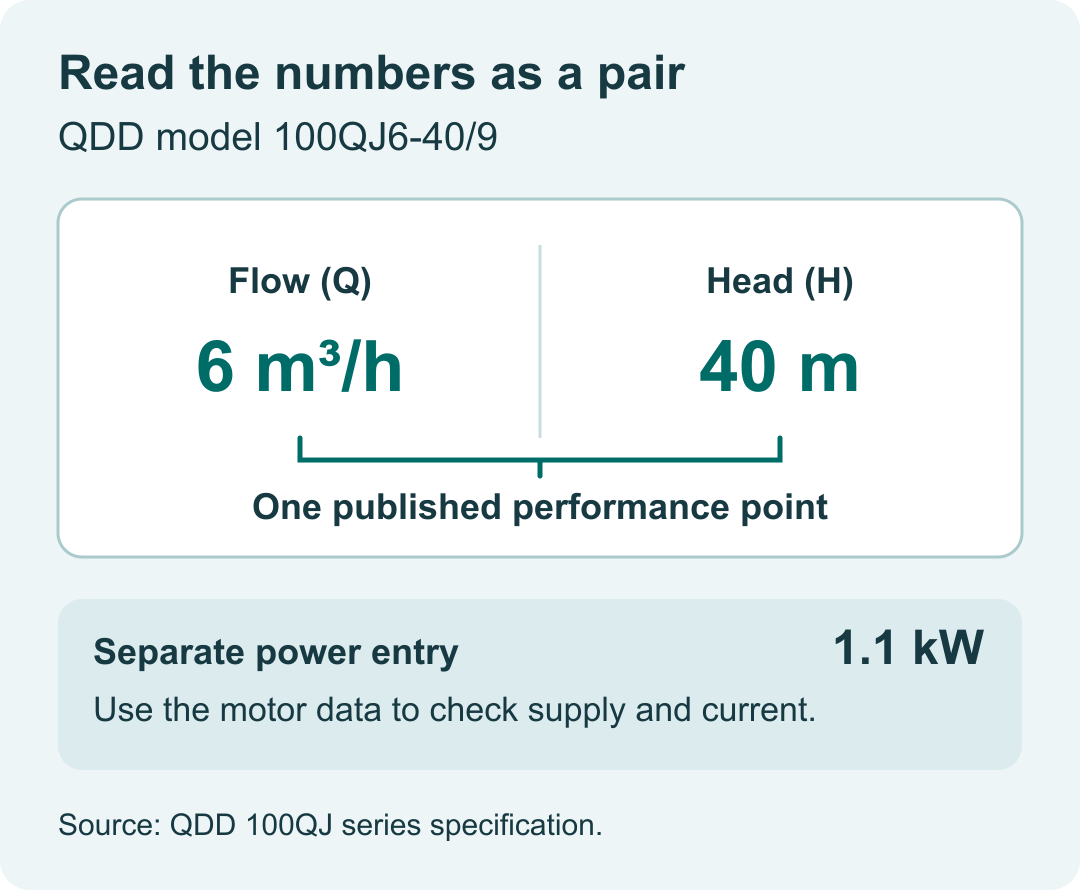
The row gives you one point to discuss with the supplier. Ask for the complete curve and the acceptable operating range for the quoted version if your target falls between listed points, or if the water level and demand change. A curve helps you see what the pump may deliver as the required head changes. The actual system flow depends on the pump and pipe system together. See the guide to reading a pump curve for a worked example of that comparison.
Turn your installation details into a duty point
Suppose an installation needs 6 m³/h. The pumping water level, which is the level in the borehole while drawing water, is 24 m below the delivery point. In this simplified example, allow 6 m for pipe and fitting losses at that flow and 10 m of head for the pressure needed at delivery. For fresh water, 10 m of pressure head is about 1 bar.
| Example input at 6 m³/h | Head to allow |
|---|---|
| Vertical lift from pumping water level to delivery point | 24 m |
| Friction through the pipe and fittings | 6 m |
| Pressure needed at delivery | 10 m |
| Total dynamic head | 40 m |
With those assumed inputs, the published 6 m³/h at 40 m gives the buyer a candidate for review. If the pumping water level falls another 7 m and the target flow and pressure stay the same, the requirement becomes 6 m³/h at 47 m. The single 40 m entry does not establish performance at that new requirement. Ask the supplier to show the available flow at the higher head or propose a suitable alternative.
Use the pumping water level at the relevant abstraction rate, not the total drilled depth or the depth at which the pump hangs. If the pump fills a vented tank, the delivery elevation is still needed, while the required outlet pressure at an open discharge is normally zero gauge pressure. If the pump feeds sprinklers or a pressurised line, include the pressure they need. Check the borehole test or ask the installer to confirm how much the well can supply over the intended pumping period. A pump rating is not a yield test.
3. Check whether the assembled pump can pass down the borehole
Treat the advertised inch size as the pump family. Ask for a dimensioned drawing and confirm the widest part of the complete assembly as it will be lowered. The pump body, motor, cable guard, cable joint, outlet adaptor and any fitted sleeve can all affect the space needed, depending on the layout.

Have your installer compare those dimensions with the narrowest usable part of the borehole along the installation path. A nominal casing size or one measurement at the top does not account for liners, couplings, changes in diameter or an obstruction deeper down. A long assembly also needs to pass through bends or offsets. When space is close, confirm the required clearance with the pump maker and the installer before ordering. Verify the outlet thread type and size separately so the discharge connection matches the pipework. Ask how the motor will get the required flow of cooling water past it once installed.
4. Read the motor and power supply separately
- Start with voltage, phase and frequency. Match the exact motor and control arrangement to the available supply. A series that shows single-phase and three-phase choices does not promise the same motor works on both. Ask the supplier to state which version is on the quote.
- Check how the motor will start and run. Ask whether that motor needs a separate control box, starter or drive. If a drive is specified, have the supplier identify its supply input and its motor output separately, along with the compatible motor and current rating. For a solar pump, ask for the controller’s permitted PV input range and the matched motor and pump data.
- Ask for the current and cable requirements. Share the actual cable run with the installer and ask for the correct cable size, motor lead length, extension and waterproof joint. A short lead shown in a product photo is not a measurement of the included cable. Rated power in kW does not replace the motor current or the manufacturer’s cable and protection information.
The QDD 100QJ page shows 240 V single-phase and 400 V three-phase options at 50 Hz as series references. Confirm which supply applies to the quoted 100QJ6-40/9 motor and ask for its nameplate data. The performance row does not specify the electrical configuration to order.
Check the exact version’s operating limits as well. If the water carries sand, the motor will see unusual temperatures, or there is little water movement past the motor, ask for the manufacturer’s permitted limits and cooling requirements. Confirm that the planned submergence, installation orientation and control protection are suitable. Leave motor wiring and protective settings to the installer using the relevant manuals.
5. Compare the sheet to what is actually on the quote
The wet end is the part of the pump that moves the water. It can be sold separately from the motor. A quote for a pump and motor may still leave the drive, cable extension and installation items to another supplier. Ask for item descriptions and quantities so that two quotes can be compared on the same basis.

| Quote item | What to confirm in writing |
|---|---|
| Pump or wet end | Full code, duty point and exact performance sheet |
| Motor | Included or separate, full code, supply and current |
| Control box, starter or drive | Included or separate, model and motor compatibility |
| Cable and joint | Included lead length, extension, joint kit and who supplies them |
| Installation parts and service | Outlet adaptor, valves, protections and installation or commissioning scope |
If an item is missing from the quote, have the supplier mark it as included, separately priced or supplied by the installer. This can change the installed cost even when two offers list the same pump power. For an existing controller or cable that you plan to keep, ask the supplier and installer to confirm compatibility before treating that item as reusable.
Send this information before you order
You can start with what you already have. Mark any unknowns and ask which ones must be resolved before the model can be confirmed.
- What the pump feeds. Tell the supplier whether it is a storage tank, a household pressure system or irrigation. Give the expected water use or required flow and outlet pressure if known.
- What is known about the borehole and pipework. Share the pump test, pumping level, usable casing diameter, delivery elevation and pipe details. If a well test or casing record is missing, ask the installer to confirm the values that affect the selection.
- What power and equipment are available. Send the known voltage, phase and frequency or the solar controller details. For a replacement, attach photos of the existing pump, motor or controller labels you can safely access.
- What you want back. Ask for the exact model and curve, the confirmed flow and head together, the maximum assembled dimensions, the motor and controller details, and a line-by-line list of what the price includes.
For a QDD quote, send your existing sheet, pump code or requirements so the proposed version can be matched to the application and the supply list checked before you order.