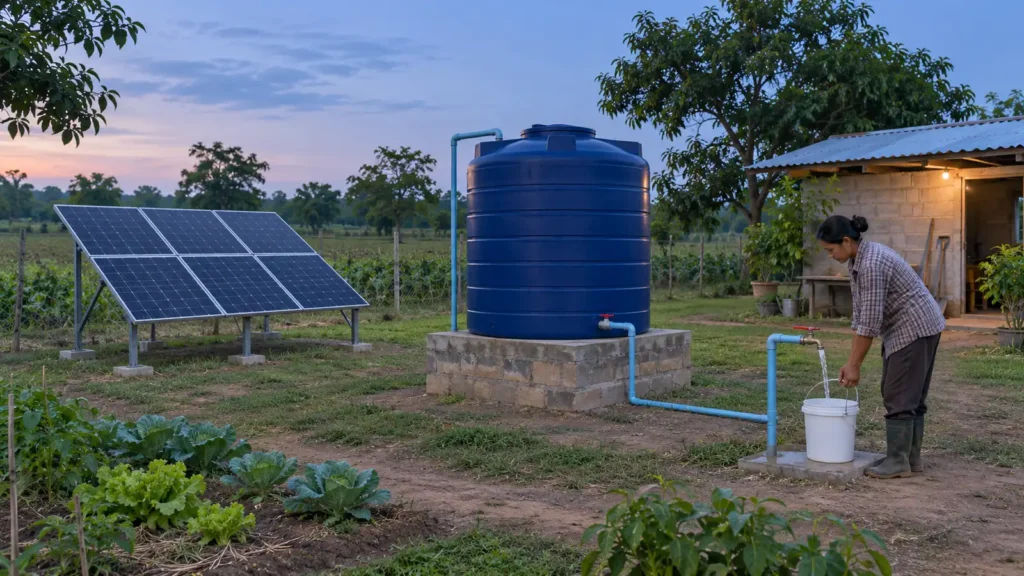
Start with a water tank if your solar pump can fill it during daylight and the tank can deliver the flow and pressure you need after dark. If gravity gives too little pressure, compare a tank with a separate booster. Consider battery-backed borehole pumping if you need the well pump itself to run after sunset and you have a compatible power system.
All three can serve the same nightly water demand. To choose between them, write down three things first. How many litres do you use between the end of useful solar pumping and the next refill? Which outlets run together? How much pressure do they need while the water is flowing? A trough, a shower and a sprinkler zone can use the same volume over a night and still place very different demands on the system.
Three ways to deliver water after dark

| Layout | When it makes sense |
|---|---|
| Daytime pumping and gravity tank | The tank can hold the required water and its lowest usable water level still gives enough pressure at the outlets. |
| Daytime pumping and tank with booster | The tank can cover the volume. A booster with a reliable night supply covers pressure the tank cannot provide by gravity. |
| Battery-backed borehole pump | The well pump needs to run after dark, the well can support that flow and schedule, and the approved electrical system can start and run the pump. |
With either tank option, the borehole pump can fill slowly during the day while the tank supplies a higher flow for a short period at night. Confirm the well can supply the planned daytime pumping rate and refill volume. With a direct battery-backed system, the well and pump have to deliver the flow demanded while the outlets are using it. A battery can extend the pumping hours. It cannot increase the well’s sustainable yield.
Check what the tank can deliver at its lowest water level
Start with usable volume
Suppose you need 2 m³ (2,000 litres) after dark. You need at least that much usable water at the start of the night if there is no refill and you plan to finish at the minimum operating level. Usable storage is the water between the full operating level and the lowest level at which you can still supply the outlets. Below that level you may lose the pressure you need, or a booster may stop on low water. A tank sold as 2,000 litres may therefore deliver less than 2,000 litres over that operating range. Check the actual levels and allow for any reserve you need to retain.
Then check pressure at the outlet
For gravity supply from a vented tank, measure from the lowest usable water surface to the point where the pressure is needed. At rest, each metre of water height gives roughly 0.098 bar. With water flowing, pipe and fitting losses reduce what is available at the outlet. A tall tank on the same level as a shower may still have too little height above the shower once it is nearly empty.

In this example, the lowest usable water surface is 8 m above the equipment inlet. The pipe and fittings lose an assumed 2 m of head at the intended flow of 2 m³/h. With the velocity head at the inlet small enough to omit for this estimate, that leaves 8 − 2 = 6 m of pressure head, about 0.59 bar at the inlet while water is flowing. If the equipment needs 1.5 bar at that flow, this gravity layout falls short even when the tank contains enough water for the night. Use your pipe size, length and simultaneous flow to check the loss. A pressure reading with every outlet closed leaves out that loss.
Raising the tank can increase gravity pressure, but it also increases the head the solar pump must overcome when filling it. Check the resulting refill volume and have the support sized for the full tank. If a longer or narrower pipe consumes much of the available head, compare the effect of improving the pipework before committing to a larger structure.
Add a booster where the water is already stored
A ground-level tank and downstream booster can work where gravity pressure is impractical. The borehole pump does the lift into storage during the day. The booster then draws from that storage and supplies the delivery flow and pressure. For the example above, ask for a layout that delivers 2 m³/h at 1.5 bar at the equipment inlet. The pressure the booster must add depends on the tank level and losses in the proposed layout. Confirm a low-water cut-off and a power source available when the booster is needed. During an outage, a full ground-level tank may still provide little or no usable pressure at elevated outlets. If outage supply matters, decide which outlets must keep working and whether gravity or an electrical backup can serve them.
Size for cloudy periods as well as the overnight gap
Choose how much interruption you can accept and check projected refill in the weaker solar season. A cloudy day can still deliver some water. The actual volume depends on sunlight, the pump and controller, pumping head and well limits. Ask for expected water delivered into the tank per day under your conditions and check how the tank recovers when good sunlight returns. The World Bank’s solar pumping guide includes water storage, demand, lift and available sunlight in that design check. Solar Pumping: The Basics
Suppose you draw 3 m³ by day and 2 m³ at night, and the pump adds 3 m³ of retained refill per cloudy day. The daily deficit is 2 m³. If you start the first day with 4 m³ available above the minimum operating level, the balance falls to 2 m³ by the next morning and zero by the morning after that. You would need more usable storage, less demand or a backup source to cover a further shortfall.

That daily balance assumes the daytime refill is retained and available when needed. Check peak use and the timing of refill too. A positive daily balance can still hide a shortage before the pump starts, or wasted refill when the tank is already full. Allow for the reserve you need to keep, the seasonal well yield and the number of low-refill days your site needs to cover. For the daytime pumping calculation, see the solar pump sizing guide.
If you need batteries, size the electrical job
Estimate energy from the electrical input and run time at the flow and head the pump will actually face. The same 2 m³ could be delivered by a booster from stored water or lifted from a deep borehole. Their input power and running times can differ. Use the measurement or supplier data for the equipment that will actually draw power from the battery system.
For an illustrative direct night supply, assume a pump and drive deliver 2 m³/h at the required 1.5 bar at the equipment inlet. At that duty, including the lift from the borehole, suppose they draw an average 0.8 kW from the AC output of a compatible inverter. In one hour they deliver 2 m³ and use 0.8 kWh. If inverter efficiency is 90% and 80% of nominal battery energy is usable, the arithmetic is 0.8 ÷ (0.90 × 0.80) ≈ 1.11 kWh of nominal battery energy, before allowances for standby use, battery ageing and temperature. The flow, input power and both percentages are assumptions. A supplier still needs to verify continuous power, startup and surge requirements, usable discharge limits and how the battery will recharge after cloudy weather.
Ask for a diagram showing where the battery connects and which charger, inverter and pump controller are approved for that arrangement. Check the approved source and input for the exact pump controller. For example, LORENTZ specifies a particular charge-control arrangement and low-voltage protection for battery operation with its S1 system. LORENTZ S1 battery guidance
Compare installed costs for layouts that meet the same demand and pressure. Include the tank, base or tower and pipework, or the battery, compatible power equipment and replacements, as applicable. With a booster include its controls and night supply. Ask about access for tank inspection and cleaning, local availability of replacement parts, and which outlets will work during an outage.
What to send to your supplier
- Demand and timing. Daily litres, litres used after dark, and the highest flow needed at one time. Name the critical outlets and their pressure requirements.
- Water source and elevations. Pumping water level and sustainable yield, proposed tank location and lowest usable water level, and elevation of the most difficult outlet. Include the pipe lengths and actual internal diameters if known.
- Solar and backup. Site location, shading, how long you need the system to work with low solar input, and which grid, generator or battery supply is available after dark.
- Equipment details. Pump, motor and controller models plus current supply details. Ask for the expected daily refill, usable storage or battery energy, delivery pressure at the target flow, and the approved backup arrangement.
For a QDD pump assessment, send those details together so the borehole refill duty, tank and any separate pressure or backup requirement can be checked against the proposed configuration. QDD solar water pumping solutions