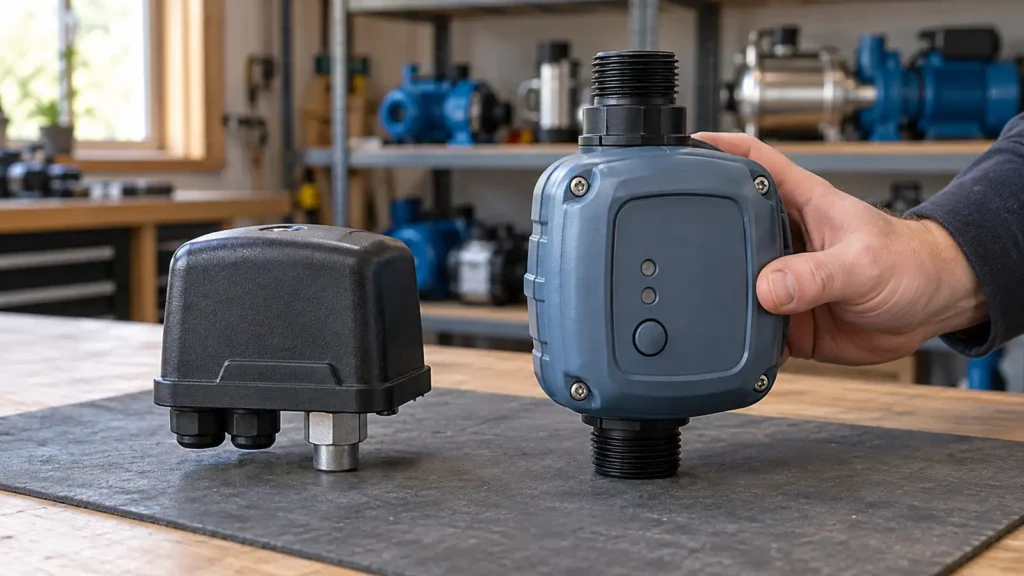
A pressure switch with a correctly sized pressure tank is often a useful starting point when a system must supply small, intermittent water demands between pump starts. A compatible electronic pressure/flow controller can provide compact automatic on/off operation, but its minimum-flow behaviour, tank requirements and protection functions need checking against the actual use. If the aim is steady pressure as demand changes, look separately at a suitable variable-speed system.
Before choosing a replacement, record the pump and motor model, the existing controller model, whether a pressure tank is fitted, and what the pump supplies. The name “automatic pump controller” alone does not describe how a device starts, stops or protects the pump.
Start with the water supply job
Supplying taps from a storage tank is a pressure-demand task. Starting a borehole pump when a storage tank becomes low and stopping it when that tank is full is a level-control task. These may be separate pumps and separate controls in the same property.
A pressure switch or an inline pressure/flow controller should not be assumed to sense the level in an open storage tank. Establish the required start and stop signals first, then select compatible equipment. A tank with a float valve that closes the delivery pipe is a different arrangement; pressure/flow control may be suitable when specified for that configuration. For a borehole supplying taps directly, also account for the borehole’s available yield and the protection needed when water availability falls.
How the two common arrangements work

Pressure switch with a pressure tank
In a conventional pressure-switch system, the pump starts when pressure at the sensing point falls to the cut-in setting and stops when it reaches cut-out. The pressure tank supplies some water after the pump stops and before the next cut-in. Its usable drawdown is the water delivered between the selected pressure settings; it is smaller than the tank’s nominal volume. Global Water Solutions explains these terms in its tank FAQ.
With a suitable tank, a small draw can be supplied without immediately starting the pump. How long that lasts depends on usable drawdown and demand. Tank size, precharge and switch settings must work together with the pump and its permitted starting frequency.
Pressure normally varies within the operating band. If demand prevents the pump from reaching cut-out, it may continue running. Raising a switch setting cannot create additional pump capacity, and an unattainable stop pressure can prevent normal shutoff.
Electronic pressure/flow controller
A common inline electronic controller starts the pump when pressure falls to its starting condition. It then uses flow detection to determine when demand has ended, stopping after its specified low-flow or no-flow condition and delay. This differs from stopping at a separately selected upper pressure threshold.
Pedrollo’s EASYPRESS technical sheet describes this pressure-and-flow approach. It also shows why “electronic means no tank” is too broad: that product can operate without an external expansion vessel, while the manufacturer recommends a small vessel. Follow the exact model’s requirements rather than applying that arrangement to every controller.
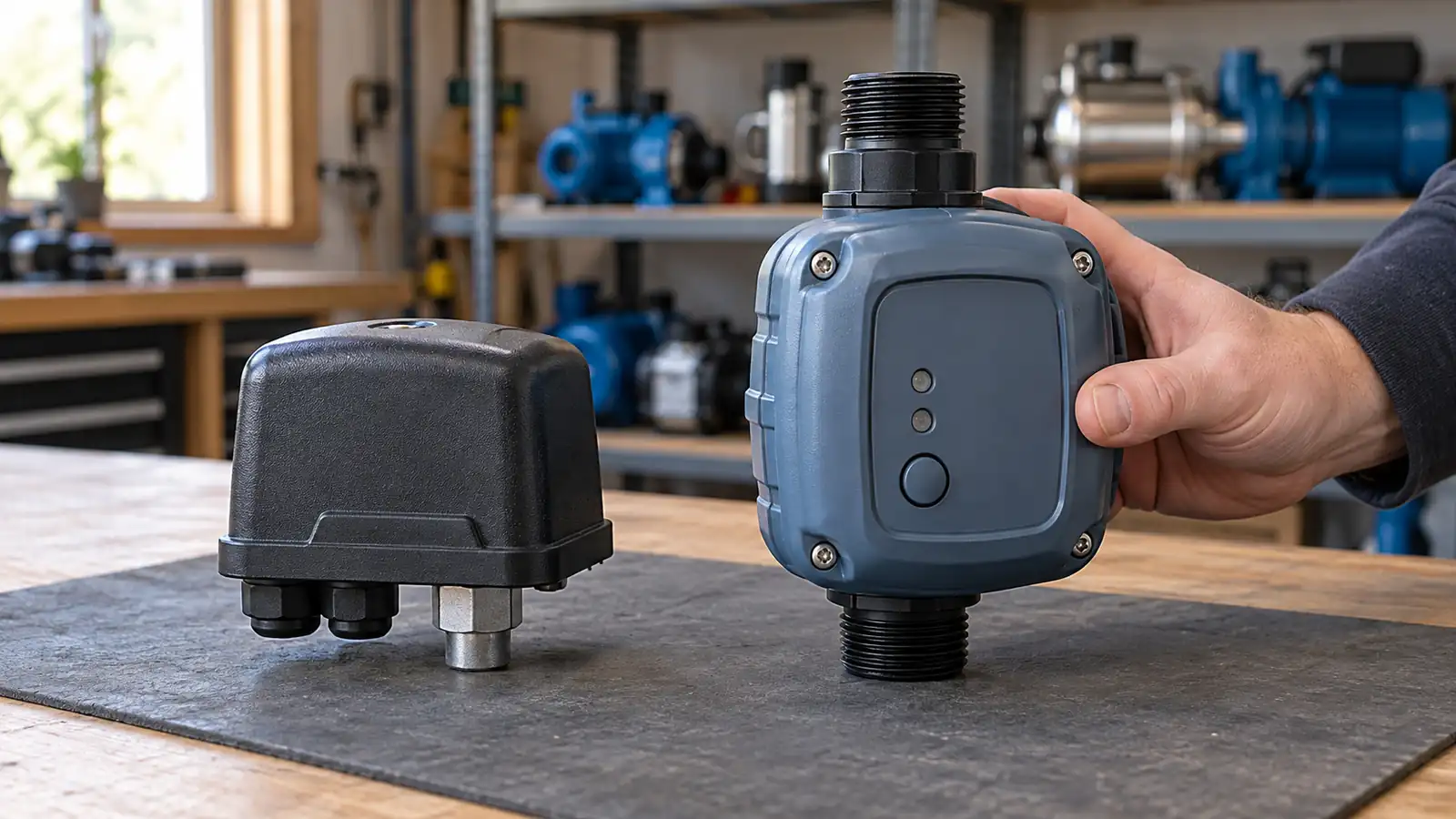
The comparison here concerns this common pressure/flow type. An electronic pressure switch can instead use pressure thresholds, and other controllers combine functions. Read the operating description, not just the casing or display.
Which arrangement suits the demand?
| Your main requirement | What to compare |
|---|---|
| Small, occasional draws | A pressure switch and suitable tank can supply stored drawdown between starts. Check the tank requirement and small-flow behaviour of any electronic alternative. |
| Sustained use, such as a hose | A compatible pressure/flow controller may be convenient while demand stays within its operating conditions. Confirm that the pump can deliver the required flow and pressure. |
| Trickle irrigation or a slow-filling appliance | Compare the smallest actual flow with the electronic unit’s stopping condition. A pressure-tank arrangement also needs enough drawdown to avoid excessive starts. |
| More stable pressure with changing demand | Compare a properly matched variable-speed solution, including its sensor, tank and minimum-demand requirements. Neither basic on/off arrangement guarantees constant pressure. |
| Filling an open storage tank | Specify low-level start and high-level stop as appropriate, with source protection. Do not substitute pressure control for the required level signals. |
The smallest normal demand deserves as much attention as the largest. A controller that works well with a fully open hose may behave differently with one drip zone or a tap barely open.
Check small flows, leaks and restart behaviour
If normal demand falls below a pressure/flow controller’s stopping threshold, the pump may stop even though a small outlet remains open. As pressure falls, it may start again, or the unit may respond according to its protection logic. Check the selected model with the actual low-demand outlet during commissioning.
A leak can also create unwanted starts. A pressure tank can delay those starts by supplying stored water, but it does not remove the leak. Some electronic controls detect frequent starts or offer delayed automatic retries after a dry-running event; these functions and their reset conditions are model-specific. The EASYPRESS operating manual is an example, rather than a universal restart specification.
Ask what happens after loss of water, a protection trip and restoration of electrical power. An automatic retry does not establish that a borehole has recovered enough water. Where source recovery matters, the protection and restart strategy must suit that source.
Match the controller to the motor and pipework
Before approving a controller, check these items together:
- Motor compatibility: supply voltage, frequency, phase, rated current and starting method. Check the device’s motor-load rating and permitted starting conditions; a general contact rating or an HP label alone is insufficient.
- Switching arrangement: establish whether the device can switch that motor directly or must signal a suitably rated starter or contactor. A control contact is not automatically a motor power output.
- Hydraulic limits: match the controller’s working-pressure and flow limits, connections, permitted orientation and pressure losses. Check the elevation of the highest outlet against its starting-pressure requirements.
- Pump pressure capability: confirm that the required operating pressure and stop conditions are achievable, while maximum possible pressure remains within the ratings of the complete installation.
- Tank and check-valve arrangement: follow the selected equipment’s instructions for tank provision, precharge, sensing points and valves. An existing component should not be removed simply because the new controller looks self-contained.
Switch contacts also have to handle the actual load type. ICS Schneider’s pressure-switch selection guidance distinguishes inductive loads and starting current from simpler contact ratings. Have the installer select the switching equipment for the motor, rather than adapting a wiring diagram from an unrelated controller.
Separate automatic control from protection and constant pressure
A basic pressure switch provides a start/stop signal; it should not be assumed to provide dry-running protection. An electronic controller may include water-loss detection, but that does not establish that it also provides every required motor or electrical protection function. Confirm the actual protection schedule, including overload and any phase-related requirements that apply to the motor.
For changing demand, a variable-frequency drive can vary motor speed using pressure feedback. DAB’s Active Driver Plus illustrates this separate class of equipment. A fixed-speed electronic on/off controller does not gain that capability simply by having a circuit board or digital display.
Even a variable-speed system needs a compatible motor, adequate water supply and a pump that can meet the duty point. Controller selection cannot correct an undersized pump, a restricted pipe or an exhausted source.
Prepare a useful control specification
Send the supplier the motor nameplate and controller model, a simple description of the water route, the pressure-tank details, and the highest and lowest normal demands. Include the required pressure at the outlets, the elevation of the highest outlet, and whether the pump supplies taps or fills a tank. State the desired behaviour after water loss and power restoration.
Ask the installer to demonstrate normal demand, the smallest intended draw, closure of all outlets, and the specified protection and reset functions using the manufacturer’s approved procedure. Record the resulting settings and operating behaviour for handover.
For a system needing a starter, level signals or coordinated motor protection, use QDD’s pump control panel requirements to frame the enquiry. The useful outcome is a documented match between pump, motor, demand and control logic.